
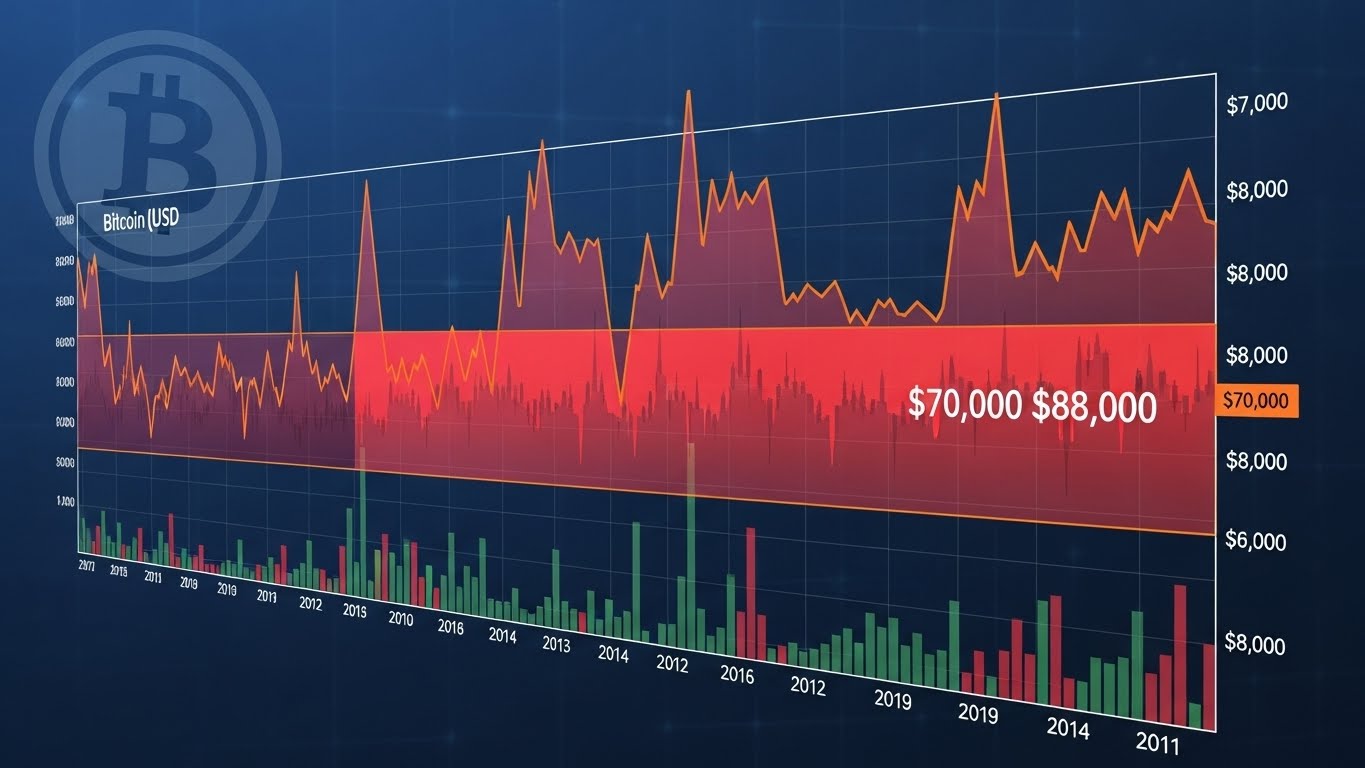
Bitcoin’s recent price behavior has drawn intense attention to the $70,000 to $80,000 zone, a range that many analysts now view as structurally important yet historically fragile. As Bitcoin climbed rapidly through this region during strong bullish momentum, it left behind what market observers describe as a gap in historical price support. This absence of well-tested support levels introduces new dynamics for traders, investors, and long-term holders, particularly during periods of consolidation or correction.
In traditional technical analysis, price zones that have been tested multiple times tend to act as reliable support or resistance. Bitcoin’s ascent into higher price discovery phases, however, has often been swift, leaving limited trading history at certain levels. The $70,000 to $80,000 zone is one such area, where price moved quickly without prolonged consolidation. As a result, this range now represents a critical zone of uncertainty that could amplify volatility in either direction.
This article explores why Bitcoin’s $70,000 to $80,000 zone highlights a gap in historical price support, how this gap formed, and what it means for Bitcoin price action, crypto market structure, technical support levels, and investor psychology. By examining on-chain data, market behavior, and historical parallels, this analysis provides a comprehensive view of why this zone matters and how it could shape Bitcoin’s next major move.
Understanding Historical Price Support in Bitcoin Markets
What Historical Price Support Really Means
Historical price support refers to price levels where buying interest has consistently emerged in the past, preventing further declines. These levels are formed through repeated interactions between buyers and sellers, creating areas of perceived value. In Bitcoin markets, support zones often align with previous cycle highs, consolidation ranges, or long-term moving averages.
When price revisits such zones, market participants tend to react predictably, either defending the level or reassessing positions. This collective behavior reinforces support over time, making it a critical component of technical analysis.
Why Bitcoin Often Lacks Dense Support Zones
Bitcoin’s long-term uptrend has been characterized by rapid expansions followed by sharp corrections. During strong bull phases, price often accelerates faster than the market can build meaningful structure. While this behavior is bullish in momentum terms, it also creates zones with limited historical interaction.
The $70,000 to $80,000 zone is a prime example of this phenomenon. Bitcoin moved through this range quickly during periods of heightened demand, leaving behind a relatively thin trading history compared to lower levels.
How the $70,000 to $80,000 Zone Was Formed
Rapid Price Discovery and Limited Consolidation
Bitcoin’s entry into the $70,000 to $80,000 range occurred during a phase of aggressive price discovery. Strong inflows, bullish sentiment, and macro-driven optimism pushed price higher with minimal resistance. While this move confirmed market strength, it also meant that price did not spend enough time in this zone to establish robust support.
As a result, the range lacks the layered buying interest typically seen in well-developed support zones. This structural weakness becomes relevant when price revisits the area under less favorable conditions.
The Role of Momentum Traders and Breakout Buying
Momentum traders and breakout strategies played a significant role in Bitcoin’s rapid ascent. Many participants entered positions above previous highs, expecting continuation rather than consolidation. This behavior reinforced upward momentum but reduced the incentive for prolonged sideways trading. Once momentum fades, however, these same participants may exit quickly, contributing to sharper pullbacks within zones that lack historical support.
Why the Support Gap Matters for Market Stability

Increased Volatility Risk
A gap in historical price support often translates into increased volatility. Without clear levels where buyers are expected to step in, price movements can become exaggerated. In the $70,000 to $80,000 zone, this means that corrections could unfold faster and with greater intensity than in areas with stronger support. Volatility is not inherently negative, but it complicates risk management and can trigger cascading liquidations in leveraged markets.
Psychological Impact on Investors
Psychology plays a crucial role in crypto markets. When investors perceive a lack of support, confidence can erode quickly. The $70,000 to $80,000 zone sits near psychologically significant round numbers, amplifying emotional responses. If price struggles in this range, uncertainty may increase, leading to hesitation among buyers and faster selling from those seeking to protect gains.
On-Chain Insights Into the Support Gap
Cost Basis Distribution and Holder Behavior
On-chain data provides insight into where Bitcoin holders acquired their coins. In zones with strong historical support, large clusters of coins share similar cost bases, indicating areas where holders may defend price.
In the $70,000 to $80,000 range, cost basis distribution appears thinner, reflecting the rapid movement through this zone. This suggests fewer long-term holders are anchored to these levels, reducing natural buying pressure during pullbacks.
Short-Term Holders Versus Long-Term Holders
Short-term holders tend to be more sensitive to price fluctuations and are more likely to sell during drawdowns. A zone dominated by short-term holders lacks the stabilizing influence of long-term conviction. The support gap in this range implies that a significant portion of activity may be driven by short-term participants, increasing susceptibility to sharp moves.
Technical Analysis Perspectives on the Zone
Support, Resistance, and Role Reversal
In technical analysis, previous resistance can become support after a breakout, a concept known as role reversal. However, this transition often requires time and repeated testing. Bitcoin’s swift move through $70,000 to $80,000 limited opportunities for such confirmation. Without multiple retests, the reliability of this zone as support remains uncertain, making it a focal point for traders watching for confirmation or failure.
Moving Averages and Trend Indicators
Longer-term moving averages often provide dynamic support during corrections. In the current structure, many key averages remain below the $70,000 level, meaning they may not offer immediate reinforcement within this zone. This separation increases the importance of horizontal support, which, as noted, is relatively weak here.
Macro Factors Amplifying the Importance of the Zone
Liquidity Conditions and Risk Appetite
Bitcoin’s price behavior is increasingly influenced by global liquidity conditions. When liquidity tightens, risk assets often face pressure, and zones with weak support can be tested aggressively. The $70,000 to $80,000 range could act as a stress test for market resilience during shifts in macro sentiment.
Institutional Participation and Market Structure
Institutional investors often rely on technical levels and risk frameworks. A lack of clear support in this zone may influence how institutions size positions or manage exposure, potentially reducing buying interest during pullbacks. This dynamic reinforces the structural vulnerability of the range.
Comparing This Zone to Past Bitcoin Cycles
Historical Parallels of Thin Support
Previous Bitcoin cycles have featured similar zones where price moved too quickly to build structure. In many cases, these areas later experienced sharp retracements until stronger support was found below. These historical parallels do not guarantee repetition, but they highlight recurring patterns in Bitcoin’s market behavior.
Lessons From Past Corrections
Past corrections often filled in structural gaps by forcing price to consolidate or retrace into stronger support zones. This process, while uncomfortable, contributed to healthier long-term trends. The $70,000 to $80,000 zone may represent a similar phase in Bitcoin’s ongoing evolution.
Implications for Traders and Investors
Risk Management in a Support-Light Zone
For traders, the lack of historical support necessitates stricter risk management. Stop placement, position sizing, and volatility expectations must account for the possibility of rapid moves. Investors, meanwhile, may need to reassess assumptions about downside protection within this range.
Strategic Accumulation Versus Waiting for Confirmation
Some participants may view pullbacks into this zone as opportunities, while others may wait for confirmation of support before committing capital. Both approaches reflect different risk tolerances and time horizons. Understanding the structural characteristics of the zone helps inform these decisions.
Potential Scenarios for the $70,000 to $80,000 Range
Successful Support Formation Through Consolidation
One possible outcome is that Bitcoin consolidates within this range, gradually building support through sustained trading activity. Over time, this could transform the zone into a more reliable foundation for future advances. Such consolidation would reduce volatility and strengthen market structure.
Breakdown Toward Lower Established Support
Alternatively, failure to hold this zone could lead to a retracement toward lower levels with stronger historical support. While this scenario may appear bearish in the short term, it could ultimately contribute to a healthier trend by reinforcing structural integrity. Both scenarios underscore the importance of patience and adaptability.
Long-Term Outlook Beyond the Support Gap
Structural Gaps as Part of Price Discovery
Structural gaps are a natural consequence of price discovery in emerging assets. Bitcoin’s limited history at higher price levels means such gaps are inevitable as the market explores new territory. Over time, continued trading activity will fill in these gaps, creating more robust support structures.
Maturation of Bitcoin’s Market Structure
As Bitcoin matures, price movements may become more orderly, with fewer extreme gaps. Increased liquidity, institutional participation, and derivative markets all contribute to this maturation. The $70,000 to $80,000 zone may be remembered as a transitional phase in this process.
Conclusion
Bitcoin’s $70,000 to $80,000 zone highlights a clear gap in historical price support, exposing both risks and opportunities for market participants. Formed during rapid price discovery, this range lacks the dense trading history that typically provides stability during corrections. As a result, it has become a focal point for volatility, sentiment shifts, and strategic decision-making.
Understanding why this support gap exists and how it influences market behavior is essential for navigating the current environment. Whether the zone evolves into a solid foundation through consolidation or gives way to a deeper retracement, its significance cannot be ignored. Ultimately, this phase reflects Bitcoin’s ongoing journey through price discovery, where uncertainty and opportunity coexist in shaping the future of the market.
FAQs
Q: Why is the $70,000 to $80,000 zone considered weak in historical support?
The zone is considered weak because Bitcoin moved through it rapidly without prolonged consolidation. This limited trading activity means fewer buyers have established positions there, reducing natural support during pullbacks.
Q: Does a lack of historical support guarantee a price drop?
No, a lack of historical support does not guarantee a drop. It simply increases uncertainty and volatility. Price can still hold the zone if new buyers step in and build support over time.
Q: How does this support gap affect long-term investors?
Long-term investors may view the gap as part of normal price discovery. However, it may influence timing decisions, as some investors prefer to accumulate at levels with stronger historical support.
Q: Can consolidation fix the support gap?
Yes, consolidation can gradually build support by increasing trading volume and establishing a clearer cost basis for holders. Time spent in the zone is a key factor in strengthening support.
Q: What lessons does this zone offer for future Bitcoin cycles?
The $70,000 to $80,000 zone highlights how rapid rallies can create structural weaknesses. Future cycles may see similar patterns, reminding investors of the importance of market structure alongside momentum.