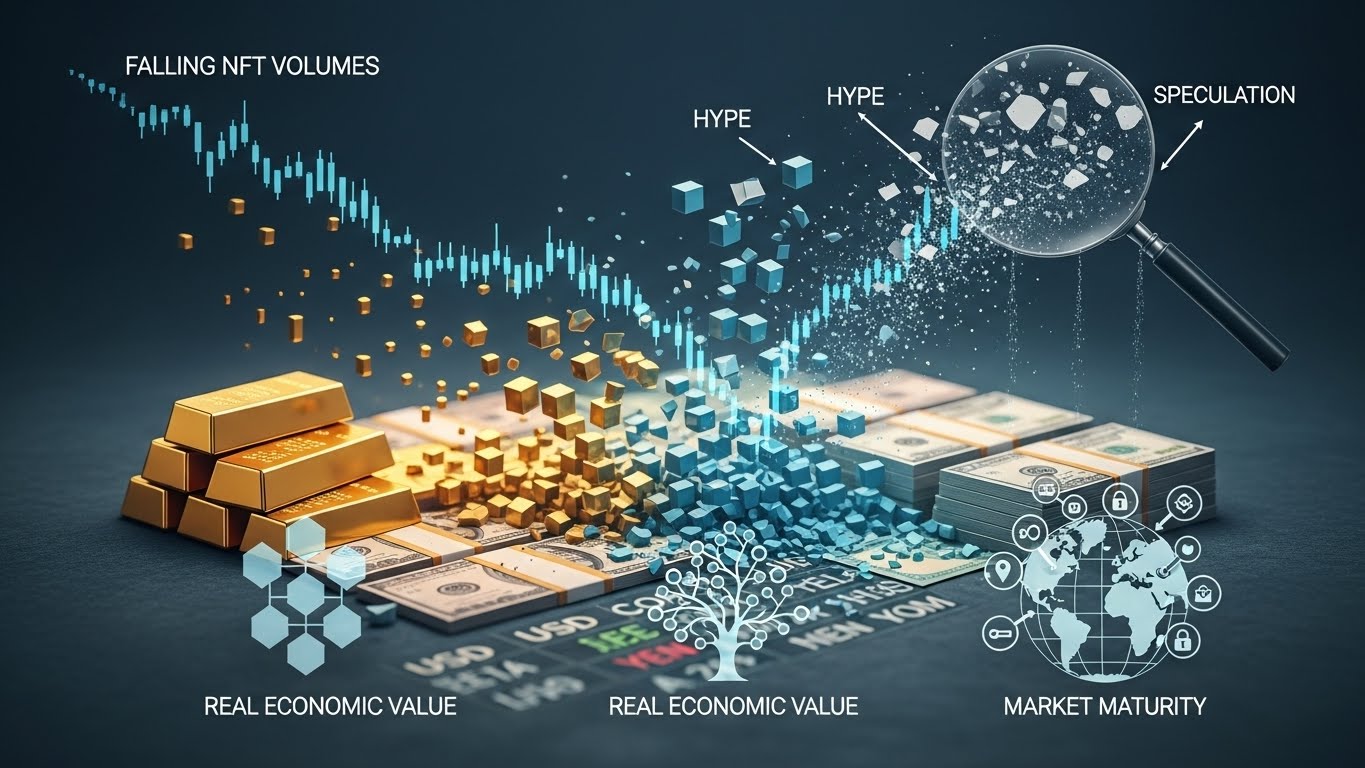
Falling NFT volumes have become one of the most discussed signals in the digital asset world, often treated as proof that NFTs have “failed” or that the entire market was nothing more than a passing fad. But that surface-level interpretation misses the real story. What falling NFT volumes actually show about economic value is not simply that people are buying fewer JPEGs. It reveals something far more important: how markets correct themselves, how speculation fades, and how true value begins to emerge when hype no longer dominates behavior.
To understand this properly, it helps to remember what NFT volume represents. Volume is not the same thing as value. Volume measures how frequently NFTs are being traded and the total amount spent in those trades. During boom cycles, volume tends to surge because traders flip assets rapidly, chasing price appreciation rather than holding for long-term utility. When a cycle reverses, volumes fall because the speculative churn dries up. That decline can look like market collapse, but in reality, it often marks the moment when the market starts separating inflated pricing from sustainable economic value.
The truth is that falling NFT volumes can be a sign of a healthier ecosystem forming. It’s the market saying, “We’re done paying for hype alone.” It’s a shift from raw speculation to a slower, more deliberate phase where long-term use cases matter. And this is exactly where economic value becomes easier to measure, because the noise of constant flipping fades.
In this article, we’ll explore what falling NFT volumes actually show about economic value in practical, real-world terms. You’ll learn how to interpret NFT volume declines, why they happen, what they reveal about market efficiency, and how they relate to broader economic forces like liquidity, consumer confidence, and risk appetite. We’ll also look at what this means for creators, collectors, investors, brands, and the future of digital ownership.
Understanding NFT Volume: What It Measures and What It Doesn’t
NFT volume is frequently misunderstood because many people assume it reflects demand for NFTs as a concept. In reality, volume reflects demand for trading activity. That is a crucial difference. A market can have high demand but low trading volume if people are holding assets instead of flipping them. Similarly, a market can have high volume with weak demand if a small group of speculators is trading among themselves in a frenzy.
When people say falling NFT volumes are bad, they often mean fewer people are trading. But what falling NFT volumes actually show about economic value is that the market may be transitioning away from short-term trading behavior. During the peak NFT cycle, a large percentage of transactions were driven by speculative motives rather than meaningful ownership or usage. Once the expectation of quick profits disappears, the incentive to trade frequently declines, and volume falls naturally.
Another key factor is that volume is heavily influenced by pricing. If floor prices drop, the same number of trades can generate lower volume. So a decline in volume can reflect lower prices rather than reduced participation. And lower prices are not always negative. Sometimes lower prices are simply a return to fair value after an overheated bubble.
This is why looking only at falling NFT volumes without context leads to incorrect conclusions. Volume must be interpreted alongside metrics like unique buyers, unique sellers, holding periods, and utility adoption. Falling volumes, when paired with stable or improving user fundamentals, can actually show that economic value is consolidating rather than disappearing.
The Speculation Cycle: How Hype Inflates Volume Without Creating Value
Every new market experiences a speculation cycle. NFTs were no exception. The early phase of the NFT boom was fueled by novelty and explosive narratives about digital ownership and the future of culture. That excitement brought in traders, influencers, and opportunists. High demand for quick profits created rapid flipping. The result was huge transaction volumes, but much of that activity was not connected to durable economic value.
What falling NFT volumes actually show about economic value is that speculative volume was never the same as sustainable value. Many NFTs were priced based on social momentum rather than utility, scarcity, or income potential. In classic bubble behavior, people bought because they expected others to buy later at higher prices. That dynamic creates volume because assets change hands repeatedly.
When the cycle turns, the mechanism collapses. People stop buying at higher prices. Traders disappear. Volume falls. But the fall isn’t necessarily the destruction of value. It’s the removal of artificially inflated activity that masked the true size of real demand. This is the same phenomenon seen in other asset classes. In housing bubbles, volume spikes as people flip homes. When speculation fades, volume drops. Yet housing as a real asset does not stop being valuable. The market simply resets toward fundamentals. NFTs follow that same economic logic, even if the cultural narrative makes it feel different.
Economic Value vs Market Price: Why Lower Volume Can Mean Better Pricing

Economic value is what something is worth based on its usefulness, desirability, or ability to generate future benefits. Market price is what people pay today under current conditions. In speculative markets, market price can drift far away from economic value because emotions and narratives overpower fundamentals.
Falling NFT volumes often signal that the market is returning to a more rational pricing environment. When there are fewer speculative trades, prices tend to stabilize. Buyers become more selective and focus on NFTs with clearer utility or cultural relevance. Sellers become more realistic and stop relying on hype. In other words, falling NFT volumes can function as a cleansing mechanism that helps the market rediscover economic value.
This shift is especially important for creators and long-term builders. During hype cycles, projects that promise little can still attract attention and volume. In quieter markets, only meaningful offerings stand out. That benefits innovation because resources flow toward genuine use cases rather than short-lived trends.
To put it simply, what falling NFT volumes actually show about economic value is that the NFT space may be evolving from a speculative casino into a more disciplined market where value has to be earned.
The Role of Liquidity: Why Liquidity Shrinkage Drives Falling NFT Volumes
Liquidity is the ease with which assets can be bought and sold without significantly affecting their price. NFTs are naturally less liquid than fungible assets because each NFT is unique and markets are fragmented. During boom phases, liquidity increases because there are more buyers and sellers active at the same time. That makes trading easier and volume rises.
When sentiment shifts, liquidity shrinks. Buyers hesitate. Sellers compete. Spreads widen. Prices become harder to agree on. As liquidity declines, volume falls. This is not unique to NFTs. It happens in stocks, real estate, and collectibles too. The key difference is that NFTs, due to their uniqueness, are more sensitive to liquidity conditions.
What falling NFT volumes actually show about economic value here is that the NFT market is responding to liquidity constraints and broader financial conditions. When interest rates rise, investors often reduce exposure to risky assets. When consumer confidence declines, discretionary spending drops. NFTs sit at the intersection of risk investment and discretionary culture, so volumes are highly responsive to liquidity shifts.
That doesn’t mean NFTs have no economic value. It means that the ability to trade them frequently depends on a healthy liquidity environment. Lower liquidity makes the market slower, but it can also encourage longer-term ownership, which is often where real value is created.
Macroeconomic Signals: NFTs as a Reflection of Risk Appetite
NFT volumes do not exist in isolation. They reflect broader macroeconomic conditions. When money is cheap, capital flows into speculative and experimental assets. When money becomes expensive, those assets lose favor. This is why falling NFT volumes often coincide with tighter monetary policy, reduced liquidity, and weakening risk appetite in global markets.
What falling NFT volumes actually show about economic value is that NFTs are not immune to economic cycles. When consumers face inflation pressures, higher borrowing costs, or uncertainty about jobs, they spend less on digital collectibles. When investors see safer yields in traditional markets, they take fewer risks.
These conditions do not erase the core concept of NFTs. They simply reduce the intensity of market activity. In many ways, falling NFT volumes can be interpreted as a reality check that places NFTs in the same category as other risky assets rather than treating them as a magical exception to economic rules.
This is also why the long-term future of NFTs will depend less on speculative volume and more on how NFTs integrate into everyday digital experiences. Markets that rely on constant risk appetite are fragile. Markets that connect to real consumption habits are resilient.
Utility Wins in Quiet Markets: The Difference Between Status and Function
During the hype era, many NFTs were bought as status symbols. Owning a certain collection signaled membership, wealth, and online relevance. That status-driven demand can create massive volume but does not always create lasting economic value, especially when attention shifts.
In contrast, NFTs with clear utility tend to hold value better in low-volume periods. Utility can mean access rights, membership perks, digital identity functions, gaming items, licensing rights, or participation in ecosystems. When volume falls, buyers focus more on function than status because they are no longer motivated by the expectation of quick flips.
This is one of the strongest answers to what falling NFT volumes actually show about economic value. They reveal which NFTs are held because they do something and which were held because they were trending. The market becomes a filter. Projects with real function become more durable, while projects that depended purely on hype fade away.
This is also where digital ownership becomes more meaningful. True ownership is not just about holding a token; it’s about what ownership enables. In quieter markets, enabling value matters more than attracting attention.
The Creator Economy: How Falling NFT Volumes Reshape Sustainable Income
One of the most important NFT promises was empowering creators. But during the peak volume era, creators often benefited from a short-lived wave of high-priced mints rather than stable long-term income. When NFT volumes fall, the creator economy shifts.
Creators who relied on mass hype struggle, while creators who build long-term communities can thrive. Lower volume pushes creators to focus on repeat engagement, meaningful rewards, and ongoing experiences rather than one-time sales. This is healthier for economic value because it aligns creator income with sustained audience value rather than pure speculation.
What falling NFT volumes actually show about economic value in the creator economy is that the market is becoming more like a real business environment. Creators need consistent demand, not just viral moments. That encourages better storytelling, stronger products, and deeper community-building.
This also ties into community-driven value, where ownership feels like participation rather than a tradeable lottery ticket. When volumes are low, the people who remain are usually more committed, and that commitment can generate more stable long-term economic value than temporary hype ever could.
NFT Market Maturity: Why Declining Volume Can Signal Growth, Not Collapse
Markets mature in stages. The first stage is discovery, where early adopters experiment. The second stage is mania, where attention explodes. The third stage is correction, where reality returns. The fourth stage is integration, where the market becomes a normal part of the economy. NFTs are moving through that process. Falling NFT volumes may represent the correction stage, which is painful but necessary. This is when weak projects disappear, scams become easier to spot, and consumer trust begins rebuilding slowly.
What falling NFT volumes actually show about economic value is that the NFT market is learning how to price assets properly. In a mature market, volumes are not fueled by nonstop flipping. They are fueled by real demand for products and experiences. Lower volume today can be the foundation for stable volume tomorrow. This is also why market efficiency improves during downturns. When money is not flying around, participants become more analytical. That reduces mispricing and increases the quality of investment decisions.
Cultural Value vs Financial Value: NFTs as Digital Collectibles
NFTs sit in a unique space because they blend financial markets with cultural markets. Cultural value is not always measured in immediate price action. Art, collectibles, and cultural artifacts often go through long periods of low liquidity. Yet they can maintain significance and value over time. When NFT volumes fall, many observers assume the cultural relevance of NFTs has collapsed. But cultural relevance does not require constant trading. In fact, cultural artifacts often become more meaningful when they are owned long-term rather than flipped endlessly.
What falling NFT volumes actually show about economic value is that NFTs are beginning to behave more like traditional collectibles. In collectible markets, liquidity is limited, and volume spikes only around major events or trends. Most of the time, owners hold. That does not make the assets worthless. It makes them collectible. This is where digital scarcity plays an interesting role. Scarcity can create value, but scarcity alone is not enough. A scarce item must also matter culturally or functionally. Falling NFT volumes expose which scarce items actually matter.
The Wash Trading Factor: How Cleaner Markets Reduce Volume
Another reason NFT volumes fell is that reported volume during boom periods was often inflated by wash trading and artificial activity. Wash trading occurs when someone trades an asset back and forth, often between wallets they control, to create the illusion of demand. As marketplaces introduced stricter policies and as scrutiny increased, some of this artificial activity declined. This means falling NFT volumes may partly reflect a cleaner market rather than weaker demand.
What falling NFT volumes actually show about economic value is that we may now be closer to seeing the real size of the NFT economy. A smaller but more authentic market is far more valuable than a massive market based on manipulation. Real economic value depends on trust. Trust grows when volume represents real buyers making real decisions. This also supports the idea of transparent price discovery, where prices reflect genuine market interest rather than inflated signals.
Where Economic Value Actually Lives in NFTs Today
If falling NFT volumes are not simply “bad,” then where does value actually live now? Economic value in NFTs tends to concentrate in a few areas. First, NFTs with strong brand identity and long-term storytelling still hold cultural value because people want to be part of that narrative. Second, NFTs that provide utility through access, membership, or functional benefits retain value because they deliver something tangible. Third, NFTs integrated into games and digital worlds can hold value because they operate like items with demand driven by gameplay. Fourth, NFTs used for licensing and IP rights can carry value because they grant economic opportunities beyond resale.
What falling NFT volumes actually show about economic value is that NFTs are gradually shifting into these more grounded categories. Instead of a broad market where almost anything can pump, value concentrates in assets with purpose, community, and longevity. That concentration is normal. In any maturing market, most projects fail and a smaller set becomes foundational.
What Falling NFT Volumes Mean for Investors and Collectors

For investors, falling NFT volumes change the strategy. In high-volume markets, short-term flipping can work because liquidity is abundant. In low-volume markets, flipping becomes harder. That shifts the focus toward long-term conviction and fundamental analysis. Collectors also benefit from lower volumes because prices become more accessible and communities become less dominated by speculation. Collectors can focus on taste, meaning, and personal connection rather than chasing momentum.
What falling NFT volumes actually show about economic value in this context is that NFT ownership becomes less about trading and more about holding. The people who remain are often those who care about the assets themselves. That can strengthen communities and stabilize value over time. This doesn’t mean risk disappears. NFTs remain volatile and experimental. But the shift from a trading-driven environment to a value-driven environment is a sign of progression, not failure.
Conclusion: The Real Lesson Behind Falling NFT Volumes
What falling NFT volumes actually show about economic value is not the death of NFTs. It is the collapse of an unsustainable speculation engine and the emergence of a more realistic market. Volume declines reveal the difference between hype-based activity and durable demand. They highlight the importance of liquidity, macroeconomic conditions, and market maturity. They expose which NFTs deliver utility, cultural significance, and long-term ownership benefits. And they show that NFTs are entering a phase where value must be justified rather than assumed.
A quieter NFT market is not necessarily a weaker market. It can be a more honest market. If NFTs are going to become a lasting part of the digital economy, they need to survive without mania. Falling NFT volumes may be uncomfortable, but they are also a necessary signal that the market is learning how to create and measure true economic value.
FAQs
Q: What falling NFT volumes actually show about economic value for long-term adoption?
Falling NFT volumes actually show about economic value that long-term adoption depends on more than trading activity and hype. When volumes drop, the market stops rewarding projects simply for being trendy and begins rewarding projects that provide ongoing benefits, strong communities, and real use cases. This creates a healthier environment for adoption because it builds trust, reduces manipulation, and makes it easier for brands and mainstream users to explore NFTs without feeling like they are entering a casino. Over time, sustainable adoption is more likely to grow from meaningful ownership experiences than from speculative trading.
Q: Why do falling NFT volumes often happen during broader economic uncertainty?
Falling NFT volumes actually show about economic value that NFTs behave like high-risk discretionary assets, meaning they are sensitive to inflation, interest rates, and consumer confidence. During uncertain economic periods, people tend to reduce spending on non-essential items and investors often shift toward safer assets. This leads to lower liquidity and fewer speculative trades in the NFT market. The decline does not automatically mean NFTs have no value; it means the market is adjusting to the same financial pressures that affect many other risk-driven asset classes.
Q: Can falling NFT volumes be a positive sign for creators and builders?
Yes, falling NFT volumes actually show about economic value that creators and builders have an opportunity to focus on long-term sustainability instead of short-term hype. In high-volume periods, creators might be tempted to chase trends and quick mint revenue, but quieter markets encourage deeper community-building, better storytelling, and more utility-driven experiences. This shift helps creators build loyal audiences and recurring value rather than relying on one-time sales. Over time, that can create a stronger foundation for both creative freedom and stable income.
Q: How can collectors identify economic value when NFT volume is low?
When volume is low, what falling NFT volumes actually show about economic value is that buyers must be more selective and focus on fundamentals. Collectors can evaluate whether an NFT has cultural relevance, long-term community engagement, genuine scarcity, and practical utility. They can also examine how consistently the project delivers value to holders and whether interest remains steady even without hype. Low volume environments reward patience and conviction, making it easier to see which assets people truly want to own rather than simply flip.
Q: Will NFT volumes rise again, and what would that say about economic value?
NFT volumes can rise again, but what falling NFT volumes actually show about economic value is that the quality of volume matters more than the quantity. If volumes rise because of real adoption, improved utility, gaming integration, and broader mainstream use, it would signal genuine economic value growth. However, if volumes rise mainly due to speculative flipping and hype cycles, it may indicate another temporary bubble rather than lasting value creation. The healthiest future is one where volume grows gradually alongside real-world integration and trustworthy market infrastructure.