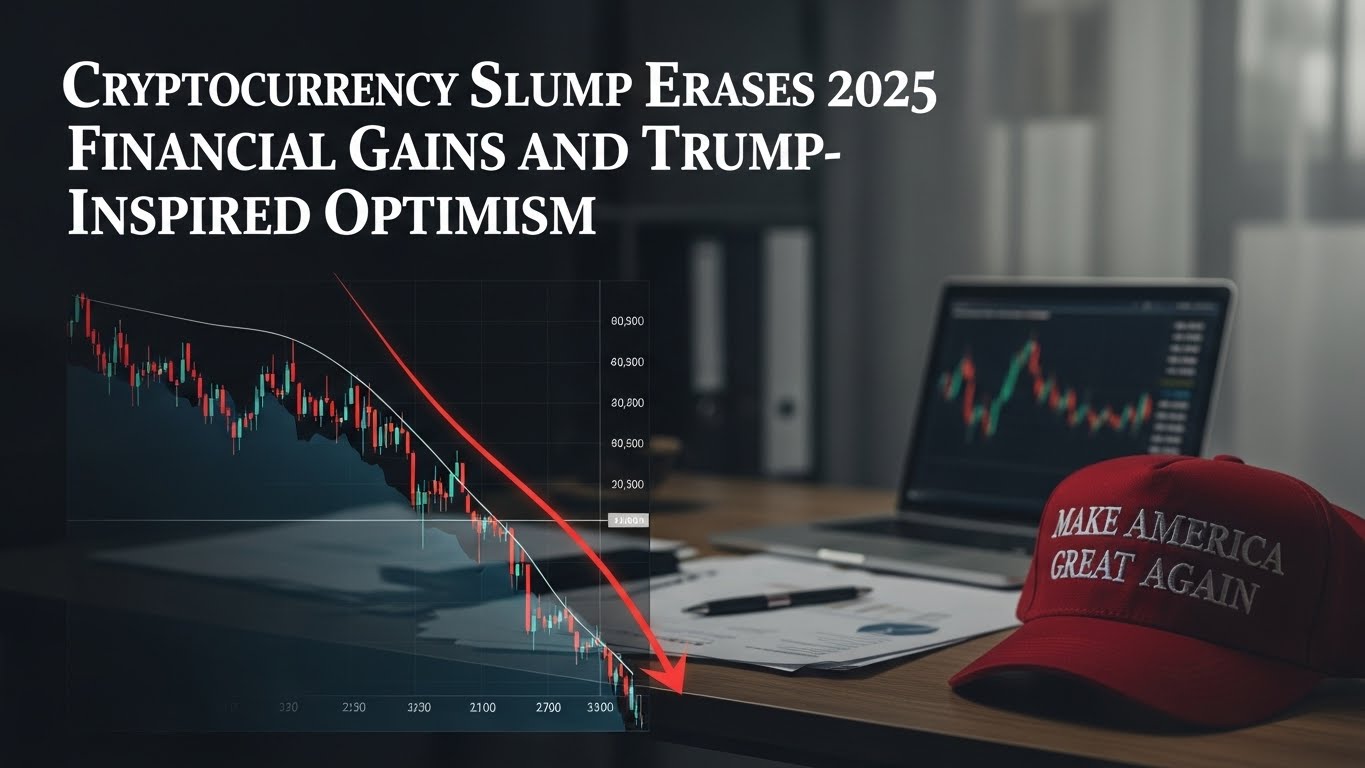
The phrase “cryptocurrency slump erases 2025 financial gains and Trump-inspired optimism” captures a sharp mood shift that many investors didn’t expect to feel this late in the year. For much of 2025, crypto markets looked unstoppable. Prices climbed, headlines celebrated new all-time highs, and optimism surged as Donald Trump’s pro-crypto messaging and early policy direction fueled confidence. The year began with renewed energy around regulatory clarity, institutional participation, and the idea that the United States might become a global hub for digital assets. That optimism wasn’t only emotional; it showed up in prices, inflows, and trading behavior.
But as the year approached its end, the market turned. The cryptocurrency slump erases 2025 financial gains and Trump-inspired optimism not because crypto suddenly lost its purpose, but because markets rarely move in straight lines. Risk assets are especially vulnerable when the macroeconomic environment tightens, investor liquidity shrinks, and geopolitical tensions reprice uncertainty. In 2025, the crypto rally was also heavily influenced by a political narrative—one that suggested a friendlier environment for digital assets. When market stress hit, that narrative couldn’t protect traders from volatility.
What Happened in 2025 and What Investors Should Learn Before 2026
This is where many people get confused. They assume that a market slump means the entire idea is broken. In reality, a slump often reveals the difference between speculative momentum and lasting economic value. It also highlights how much crypto depends on broader forces such as interest rates, inflation expectations, institutional positioning, and policy credibility. The cryptocurrency slump erases 2025 financial gains and Trump-inspired optimism because markets recalibrate quickly when conditions change, and crypto is one of the fastest-moving, most sentiment-driven markets in the world.
This article explains what happened, why it happened, and what the slump truly says about crypto’s future. We’ll explore how Trump-inspired optimism helped drive early 2025 gains, what triggered the reversal, how Bitcoin price volatility and altcoin market weakness amplified the downturn, and what investors can learn before 2026 begins.
The 2025 Crypto Rally: How Financial Gains Built Up Before the Slump
Early 2025 delivered one of those classic “risk-on” stretches where enthusiasm spreads faster than skepticism. Bitcoin and major altcoins pushed higher as traders priced in a friendlier U.S. stance toward crypto. Momentum also benefited from prior infrastructure developments like regulated market access and the continued normalization of institutional participation. When large investors feel confident, liquidity improves, spreads tighten, and price discovery becomes smoother. That environment tends to support rallies.
A major feature of the rally was narrative strength. In crypto, stories can become catalysts. “Trump-inspired optimism” became shorthand for a belief that regulators would ease pressure, that innovation would face fewer roadblocks, and that capital would move more freely into digital assets. For many investors, it wasn’t only about who was in power, but what direction the policy environment seemed to be taking.
Why 2025’s Crypto Boom Turned Into a Fast Collapse
The result was that 2025 financial gains built up across the board. Bitcoin surged dramatically from its earlier levels and reached new highs later in the year, and several large-cap altcoins rode the wave. Many retail investors returned, while professional traders increased exposure through structured products and derivatives. Even crypto-adjacent public companies gained market attention, reinforcing the belief that the cycle had turned bullish for the long term.
But the same ingredients that power fast gains also increase fragility. When leverage increases and prices rise quickly, markets become sensitive to shocks. That’s why, when the cryptocurrency slump erases 2025 financial gains and Trump-inspired optimism, it can happen with surprising speed. The same enthusiasm that fueled the climb can flip into fear once key levels break.
Why the Rally Felt Different: Institutional Participation and Policy Narratives
One reason the 2025 rally felt more “serious” than earlier cycles was the perception that crypto had matured. Institutional players were no longer outsiders; they were part of the system. Their presence can stabilize markets in some periods, but it can also intensify downside moves when risk managers reduce exposure quickly.
At the same time, policy narratives mattered more than ever. Crypto is still deeply affected by regulation, because regulation influences exchange access, banking relationships, stablecoin infrastructure, tax clarity, and the ability of companies to build in the open. Trump-inspired optimism boosted expectations that these constraints would ease. When markets saw early signs of support, it reinforced bullish positioning.
However, narrative-driven rallies often face a problem: they can run ahead of deliverables. If legislation, implementation details, or economic conditions don’t match the market’s expectations, a correction can arrive even if the long-term trajectory remains positive.
What Triggered the Downturn: Why the Cryptocurrency Slump Hit So Hard
The cryptocurrency slump erases 2025 financial gains and Trump-inspired optimism largely because multiple forces hit at the same time. Crypto rarely falls due to a single cause. It drops hardest when macro pressure, liquidity reduction, and technical breakdowns overlap.
One major driver was rising uncertainty in global markets. When volatility spreads in equities, commodities, or foreign exchange, crypto often reacts more dramatically because it trades 24/7 and has a high concentration of leveraged participants. Even if crypto-specific fundamentals remain steady, broader market stress can cause funds to reduce exposure to all risk assets.
Another driver was leverage unwinding. Bull markets encourage leverage because traders believe dips will recover quickly. But when price breaks key support levels, liquidations can cascade. This is why crypto downturns often look violent. Liquidations force selling, which triggers more liquidations, which accelerates the decline.
There was also a psychological shift. Trump-inspired optimism created a strong expectation that a pro-crypto environment would keep the rally intact. When the market fell anyway, it undermined confidence. That emotional reversal matters because crypto is a sentiment market. Once traders start doubting the narrative that drove their positions, they exit faster.
The Role of Tariffs, Global Risk-Off Moves, and Shock Headlines
While crypto is global, U.S. policy signals can strongly influence capital flows. When trade tensions rise or tariffs become a market concern, investors often reduce exposure to volatile assets. Tariff fears can lift inflation expectations, change interest-rate pricing, and strengthen defensive positioning across portfolios. Crypto tends to suffer in those moments because it’s still treated as a high-beta risk asset by most large investors.
This doesn’t mean crypto is “weak.” It means crypto is highly reactive. When shock headlines hit, crypto markets move quickly because liquidity can evaporate in minutes, and derivatives markets can amplify price action. That dynamic is part of why the cryptocurrency slump erases 2025 financial gains and Trump-inspired optimism so dramatically. The market is built for speed, for better and for worse.
Bitcoin’s Fall and the Domino Effect: How One Asset Pulls the Market Down

Bitcoin is still the gravity center of the crypto market. When Bitcoin falls sharply, it often drags the rest of the market with it, even projects with strong communities or solid fundamentals. This is partly psychological and partly structural. Bitcoin dominates market capitalization, serves as collateral across many trading venues, and functions as the benchmark for risk sentiment in crypto.
So when Bitcoin pulls back, traders often de-risk across the board. Liquidity flows out of altcoins first because altcoins are less liquid and more volatile. That is why the cryptocurrency slump erases 2025 financial gains and Trump-inspired optimism not only in Bitcoin but also in Ethereum, Solana, and countless smaller assets. Bitcoin’s decline also impacts crypto-linked equities and treasury companies that hold Bitcoin on their balance sheets. When those stocks drop, the negative feedback loop can intensify fear. It becomes a broader “crypto risk-off event,” not just a price dip.
Why “Erasing Gains” Feels Worse Than a Normal Correction
A key emotional element of 2025 is that the slump didn’t simply reduce profits—it erased them. Many investors could tolerate a pullback that still left them up for the year. But when prices fall back to the year’s starting point, it creates frustration and disbelief. People feel like they “wasted time,” even if they learned valuable lessons.
This emotional effect can cause additional selling. Traders who held through volatility earlier may capitulate once their year-to-date gains vanish. That accelerates downside moves and deepens the sense that the cycle has turned. It’s also why the phrase “cryptocurrency slump erases 2025 financial gains and Trump-inspired optimism” resonates so strongly. It describes not just a market move, but a mood shift from confidence to caution.
Trump-Inspired Optimism: Why Politics Can Move Crypto, But Not Control It
Crypto markets have always had a complicated relationship with politics. On one hand, regulation and policy have enormous influence on adoption. On the other, crypto is still driven by liquidity cycles, technology narratives, and global investor behavior. Political support can help, but it cannot override macroeconomic reality. Trump-inspired optimism did play a major role in 2025 sentiment. Investors believed that a more crypto-friendly administration would reduce enforcement pressure, encourage innovation, and attract capital. That belief wasn’t irrational. Regulatory tone can impact market structure and institutional comfort.
However, the slump shows the limits of political optimism. If global markets price in tighter financial conditions, higher uncertainty, or weaker risk appetite, crypto can fall even in a supportive regulatory environment. That doesn’t negate policy progress; it just means markets are bigger than politics. This is a crucial takeaway: the cryptocurrency slump erases 2025 financial gains and Trump-inspired optimism because politics influences the playing field, but liquidity and risk appetite decide the score.
The Difference Between Pro-Crypto Messaging and Market-Supporting Conditions
It’s important to separate messaging from conditions. Pro-crypto messaging can boost confidence, but markets require stable conditions to sustain rallies. These conditions include steady liquidity, predictable monetary policy, manageable inflation expectations, and healthy risk sentiment in broader markets. If those conditions weaken, crypto will likely suffer regardless of supportive language from leaders. That is why long-term investors focus on fundamentals rather than political hype. Policies matter, but they are only one piece of the puzzle.
What the Slump Reveals About Real Economic Value in Crypto
When the cryptocurrency slump erases 2025 financial gains and Trump-inspired optimism, it forces a deeper question: what is crypto actually worth, and why? The answer depends on what part of crypto you’re evaluating. For Bitcoin, the value narrative often centers on store-of-value properties, scarcity, and its role as a global alternative asset. For Ethereum, value is tied to network utility, the ecosystem of applications, and the economics of fees and staking. For many altcoins, value is tied to adoption, community, and the usefulness of the protocol.
Slumps help separate assets driven mostly by speculation from assets supported by real demand. In bull markets, almost everything rises together. In bear phases, only the strongest narratives survive. This is why downturns are often when the real winners of the next cycle are identified. Another form of value is infrastructural. The crypto space has built exchanges, custody solutions, scaling technology, stablecoin rails, and settlement networks that are increasingly useful even when prices fall. Price slumps don’t erase that progress. They simply change the incentives and timelines. This is where market correction becomes a form of discovery. It reveals which projects are resilient, which communities are durable, and where real utility exists beyond hype.
How Sentiment and Liquidity Create “Fast Value” and “Slow Value”
Crypto has two kinds of value. There’s fast value, which is driven by sentiment, headlines, and momentum. Then there’s slow value, which is built through usage, network effects, and integration into real economic activity.
The 2025 rally was heavy on fast value, supported by Trump-inspired optimism and bullish market conditions. The slump wipes out the fast value quickly, which is why it feels dramatic. But slow value remains, even if it doesn’t show up immediately in price. That includes institutional adoption, improving on-chain infrastructure, and more mature market participants.
Investor Psychology in 2025: Why Many People Bought the Top Again
A painful truth about market cycles is that human behavior repeats. During rallies, people chase performance. They buy because prices are going up, because social media celebrates winners, and because they fear missing the next big move. Crypto magnifies this behavior because it trades nonstop and encourages community-driven hype. Trump-inspired optimism added another layer. It gave investors a reason to believe the rally had political backing. That kind of narrative makes people feel safer taking risk. When the slump arrived, it caught many investors overexposed.
This matters because investor psychology influences how long downturns last. If the market becomes dominated by fear, it can take time for confidence to rebuild. However, fear also creates opportunities for patient investors who focus on fundamentals. The cryptocurrency slump erases 2025 financial gains and Trump-inspired optimism partly because traders overestimated how smooth the path would be, and underestimated how quickly leverage and uncertainty could reverse sentiment.
What Happens Next: 2026 Outlook After the 2025 Crypto Slump
After a slump, crypto markets typically enter a period of reflection. Volatility may remain high, but attention shifts to fundamentals. Investors ask whether adoption is growing, whether regulation is improving, and whether macro conditions will loosen. A key focus for 2026 will be whether institutional flows return in a meaningful way. If large investors regain confidence and macro conditions stabilize, crypto can recover quickly. But if risk appetite remains weak and liquidity stays tight, the market may remain choppy. Another focus will be regulatory follow-through. Trump-inspired optimism will only return sustainably if policy progress becomes tangible. That includes clearer rules for exchanges, stablecoins, custody, and taxation. If the market sees real steps, it can rebuild confidence even if prices remain volatile.
At the same time, innovation continues. Builders rarely stop during downturns. New use cases, scaling solutions, and integration into payments and digital finance may expand quietly, setting up future growth once conditions improve. This is why it’s too simple to say the slump “ended crypto.” More accurately, the cryptocurrency slump erases 2025 financial gains and Trump-inspired optimism, but it may also reset expectations to a healthier level.
How Smart Investors Respond to a Slump Without Panic
The most successful market participants rarely react emotionally. Instead, they reassess risk, review fundamentals, and consider time horizon. Some investors reduce exposure to manage volatility. Others accumulate gradually, focusing on assets they believe will survive multiple cycles. It’s also common to shift focus toward risk management, which is often ignored in bull markets. Slumps remind everyone that volatility is the price of admission in crypto. In 2026, investors will likely reward projects that show real traction, strong governance, and clear reasons for long-term survival.
Conclusion: The Real Meaning Behind the 2025 Crypto Slump

The cryptocurrency slump erases 2025 financial gains and Trump-inspired optimism, but it doesn’t erase crypto’s purpose or the progress made across the ecosystem. What it truly does is expose how sentiment-driven markets behave when macro conditions shift, leverage unwinds, and narratives lose power. It also highlights the limits of political optimism. Even supportive leadership cannot prevent volatility when global markets turn risk-off.
For investors, the slump is a reminder that rallies built mainly on momentum can fade quickly. For builders, it’s a chance to focus on long-term utility and real adoption. And for the broader market, it’s a necessary correction that helps separate short-lived speculation from durable innovation. If 2025 taught anything, it’s that crypto remains a high-risk, high-opportunity asset class. The key is understanding that market cycles are inevitable, and survival belongs to those who treat crypto not as a get-rich-quick story, but as a long-term evolution of digital finance.
FAQs
Q: Why did the cryptocurrency slump erase 2025 financial gains so quickly even after months of bullish momentum?
The cryptocurrency slump erases 2025 financial gains quickly because crypto markets are highly leveraged, extremely liquid on the downside, and driven by sentiment that can reverse in hours. When key support levels break, forced liquidations can create cascades of selling. At the same time, broader macroeconomic stress can push institutions to reduce risk exposure across all volatile assets, including crypto. Even strong narratives, like Trump-inspired optimism, can’t stop the mechanical effects of leverage unwinding and liquidity shrinking once market fear accelerates.
Q: How did Trump-inspired optimism influence crypto prices in 2025, and why didn’t it prevent the downturn?
Trump-inspired optimism influenced prices by boosting confidence that the U.S. would become more favorable to crypto through regulatory shifts and a supportive tone. That optimism helped attract capital and encouraged traders to take larger positions. However, the downturn shows that politics can shape the environment but cannot fully control price outcomes when macroeconomic conditions worsen. Crypto still trades like a global risk asset, so if investors turn defensive due to tariffs, inflation fears, or broader market stress, prices can fall regardless of political messaging.
Q: Does the cryptocurrency slump mean crypto adoption is failing, or is this just another market cycle?
The cryptocurrency slump erases 2025 financial gains, but it doesn’t automatically mean adoption is failing. Price action often reflects speculative positioning more than real-world usage in the short term. Adoption can still grow through infrastructure improvements, increasing institutional familiarity, and expanding use cases like settlement, tokenization, and digital payments. Slumps are common in crypto cycles and often serve as a reset that forces markets to focus on fundamentals rather than hype.
Q: What does the 2025 slump suggest about Bitcoin’s role compared to altcoins in a risk-off environment?
The slump reinforces that Bitcoin remains the core benchmark for crypto risk sentiment. When Bitcoin falls, altcoins often fall harder due to lower liquidity and higher volatility, which is why downturns can feel brutal for smaller projects. In risk-off environments, many investors rotate toward Bitcoin or stable assets because Bitcoin is perceived as the most established and resilient. This doesn’t guarantee Bitcoin won’t drop, but it often means Bitcoin holds relative strength compared to many altcoins during deep market stress.
Q: How should long-term investors think about strategy after the cryptocurrency slump erases 2025 gains?
Long-term investors typically benefit from focusing on time horizon, fundamentals, and disciplined risk management rather than chasing headlines. After the cryptocurrency slump erases 2025 financial gains, a thoughtful approach often includes reassessing portfolio exposure, avoiding excessive leverage, and concentrating on assets with strong networks, meaningful adoption, and clear long-term relevance. Investors can also consider gradual accumulation instead of trying to time the exact bottom, because crypto volatility can remain high even during recovery phases.