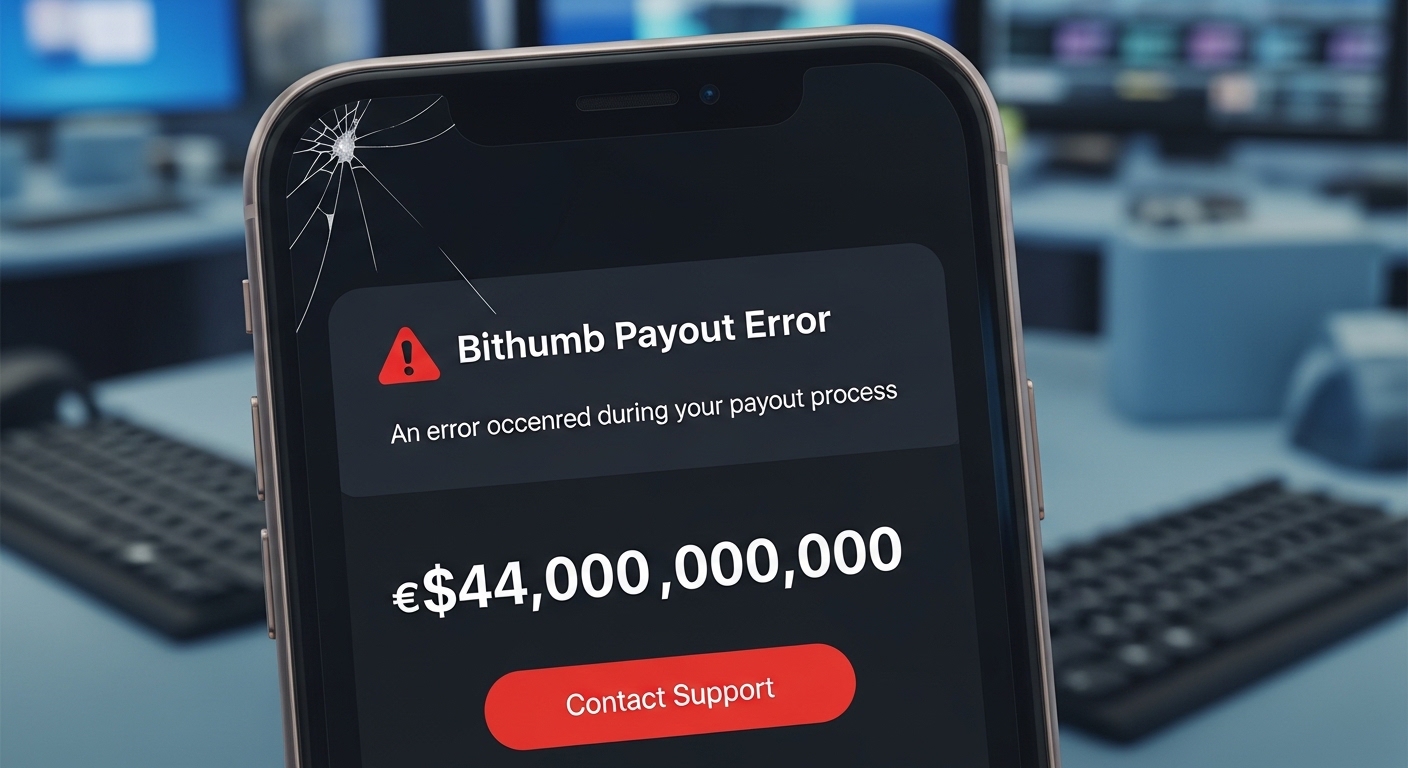
Bithumb payout error sparked panic selling and fresh scrutiny. Learn what happened, why it matters, and how exchanges can prevent costly errors. In crypto markets, trust is built on the assumption that numbers are precise. Systems are redundant, and customer balances reflect reality. That is why a single operational mishap can feel more disruptive than a steep price swing. The recent Bithumb payout error captured global attention because it combined the worst ingredients for market anxiety. A large unintended credit, frantic selling, and an urgent public apology from a major exchange. For traders who already live with volatility. An incident like this doesn’t just create a temporary chart spike—it triggers questions about internal controls, platform reliability. And how quickly an exchange can contain damage when something goes wrong.
What made this event especially alarming was the scale attached to the headline. A Bithumb payout error framed as a “$44 billion Bitcoin blunder” instantly became a viral talking point across trading desks and social feeds. Even if the broader market did not permanently reprice on the spot. The psychological impact was immediate: retail traders feared contagion, arbitrageurs hunted dislocations, and risk managers reviewed exposure to exchange-specific events. When extreme headlines collide with real order flow, the result is often a short-lived but intense storm—one that can shake weak hands out of positions and punish anyone trading without a plan.
A Costly Click That Turned Routine Rewards Into a Market Shock
Beyond the immediate drama, the deeper story is operational. A Bithumb payout error is not just an embarrassing moment; it’s a case study in how modern exchanges run complex reward systems, promotional credits, and automated distribution pipelines. These systems touch wallets, internal ledgers, and sometimes live market balances. If guardrails fail—through a misconfigured rule, a mistaken unit conversion, or an approval step skipped—the outcome can be an accidental payout that spreads faster than any manual team can respond. Once users see unexpected balances, some attempt withdrawals, others sell quickly, and the platform’s next actions determine whether confidence is restored or damaged for months.
This article breaks down what a Bithumb payout error means for traders, why accidental payouts can move prices even when they’re quickly reversed, and what best practices exchanges should adopt to reduce the chance of a repeat. You’ll also learn practical takeaways for everyday investors: how to manage platform risk, why diversification across venues matters, and how to recognize exchange-driven volatility in real time.
What Happened: Understanding the $44B Bitcoin Blunder Narrative
At the center of the story is a reported accidental credit during a promotional or reward-related process—exactly the type of operational flow that runs quietly until it doesn’t. In a Bithumb payout error, the key problem is not the promotion itself; it’s the system logic that decides the amount, the asset, and the destination account. When a routine reward becomes a massive credit, it can appear to users like a sudden windfall. That moment is dangerous because it creates instant incentive to act first and ask questions later, especially in a market where speed can mean profit.
The public apology matters because it signals the exchange recognized the Bithumb payout error as a serious incident rather than a minor glitch. In the crypto industry, communication is part of damage control. Clear messaging can reduce panic, discourage rumor spirals, and guide users toward the correct next steps. Unclear messaging can do the opposite, causing customers to assume the worst: that funds are at risk, systems are compromised, or more hidden problems exist.
A second layer involves the market impact. When a Bithumb payout error leads recipients to sell credited assets, it can push exchange-specific prices sharply lower for a brief period. This is not always a “real” market crash across all venues; it is often a localized dislocation caused by sudden supply hitting one order book. Yet localized dislocations can still matter because they trigger liquidations in derivatives connected to that venue, invite predatory bots, and amplify fear across social media, which then affects behavior on other exchanges.
Why Accidental Payouts Move Markets So Fast
A Bithumb payout error becomes market-moving because exchanges are not just custody platforms; they are liquidity hubs. If a large, unexpected balance appears in multiple accounts, the first instinct for many recipients is to convert it into something else before it disappears. That conversion becomes sell pressure. Even if the exchange later reverses transactions or recovers funds, the immediate selling can already have created a price shock that punishes traders who were positioned the wrong way.
Order Book Liquidity and Sudden Supply
Order books are not infinite pools. They are stacks of bids and asks at discrete prices. When a Bithumb payout error injects sudden supply, it can chew through bids quickly, producing a cascade of lower prints. The result often looks like a flash crash—steep, fast, and confusing. Traders watching charts may interpret it as a broader market breakdown when it’s actually a venue-specific liquidity event, and that misinterpretation can cause secondary selling elsewhere.
Leverage, Liquidations, and Reflexive Feedback Loops
Leverage turns small moves into forced moves. If the Bithumb payout error triggers a sharp drop on the exchange, leveraged long positions can be liquidated, creating more market sells and accelerating the decline. That liquidation-driven selling can overshoot, and when it does, the rebound can also be violent as liquidations end, shorts take profits, and arbitrageurs step in. This reflexive loop is why accidental payout events feel chaotic: prices move not just because of sentiment, but because the trading system forces participants into actions.
Arbitrage and Cross-Exchange Contagion
When one venue deviates from global pricing, arbitrage desks move quickly to buy cheap assets and sell them elsewhere. Ironically, that can deepen the dislocation in the short run if withdrawals are paused or if the venue’s internal transfer logic is under stress due to the Bithumb payout error. If traders suspect withdrawals might be restricted, they may avoid buying the dip on that venue, allowing the local price to remain distorted longer than expected.
The Real Risk: Trust, Controls, and Operational Resilience
The biggest consequence of a Bithumb payout error is not the headline number. It is trust. Exchanges compete on liquidity, fees, user experience, and security—but operational reliability is the invisible pillar that holds everything up. If users believe internal systems can mistakenly credit huge amounts, they may also wonder what else can go wrong: incorrect balances, delayed settlements, broken risk checks, or flawed accounting. Even if customer funds are ultimately safe, confidence can weaken, and confidence is the currency of any financial platform.
How Reward Systems Become Attack Surfaces Without Hackers
It’s important to separate “security breach” from “operational failure.” A Bithumb payout error can occur without hackers, purely through an internal mistake: misconfigured parameters, an incorrect asset ticker, or a unit mismatch between KRW rewards and BTC crediting logic. Modern exchanges run many automated workflows—airdrops, referral rewards, VIP rebates, promotional campaigns—and each workflow has permissions, triggers, and settlement scripts. When those scripts are not isolated behind strict limits, accidental payouts become possible.
Internal Controls That Should Catch a Bithumb Payout Error
Strong exchanges design systems so that a Bithumb payout error is hard to execute and easy to stop. That includes multi-step approvals for large distributions, automated sanity checks that compare intended amounts versus actual amounts, and rate limits that cap how much can be credited in any one batch. A robust system also has “kill switches” that freeze distribution instantly if an anomaly is detected, preventing a small mistake from becoming a platform-wide incident.
Communication as a Form of Risk Management
When a Bithumb payout error goes public, the exchange’s tone matters. Users want clarity: what happened, which accounts are affected, whether withdrawals are impacted, and what steps are being taken. Vague messaging can increase fear, while overly technical explanations can confuse non-expert customers. The ideal response is transparent without being sensational, firm without being defensive, and consistent across all official channels so rumors don’t fill the gaps.
What Traders Should Learn From This Incident
A Bithumb payout error is a reminder that exchange risk is part of trading risk. Many traders analyze charts, funding rates, and macro news but ignore platform-specific fragility. Yet platform incidents—outages, order mismatches, API instability, or accidental credits—can be the difference between a normal loss and a catastrophic one.
Diversify Venue Risk and Avoid Single-Point Failure
If your entire strategy depends on one exchange, you’re exposed to that platform’s operational quality. A Bithumb payout error demonstrates why distributing capital across multiple reputable venues can reduce the impact of any single incident. Even if you prefer one exchange for liquidity, holding all collateral there can be a fragile setup when unexpected events occur.
Use Conservative Leverage in Uncertain Conditions
Leverage magnifies platform-driven volatility. During a Bithumb payout error, price can move in ways that are not tied to broader market fundamentals, and liquidation engines do not care why the move happened. Keeping leverage modest and setting realistic liquidation buffers helps prevent forced exits during sudden venue-specific spikes.
Recognize the Signature of Exchange-Driven Volatility
A common pattern during a Bithumb payout error is a sharp, isolated wick or crash on one venue that is not mirrored elsewhere at the same intensity. Traders who learn to compare multiple charts quickly can identify whether a move is global or local.
How Exchanges Can Prevent Another Bithumb Payout Error
The industry often reacts after incidents, but prevention is where credibility is built. A Bithumb payout error should push exchanges to upgrade controls around promotional credits and distribution pipelines.
Hard Caps and Circuit Breakers on Reward Distribution
The simplest safeguard is a cap: no reward job should be able to credit more than a defined maximum without executive authorization. If a Bithumb payout error begins, a circuit breaker should pause the job automatically once anomalies exceed thresholds. These thresholds can be based on total distributed value, per-account value, or deviation from expected averages.
Independent Reconciliation Before Funds Become Tradable
One reason a Bithumb payout error can cause immediate selling is that credited balances become tradable instantly. A safer model is to quarantine large promotional credits into a pending state, requiring reconciliation before they can be traded or withdrawn. This approach adds friction, but it protects both the exchange and users from chaotic outcomes.
Monitoring, Alerting, and Red-Team Testing
Real-time monitoring should flag suspicious distributions within seconds. A Bithumb payout error might begin as a normal batch job, so alerts must be tuned not only for security threats but for operational anomalies. Exchanges can also conduct red-team style testing of reward systems, simulating parameter mistakes and ensuring controls hold under stress.
The Bigger Picture: What This Means for Crypto Market Maturity
Every high-profile operational incident becomes a referendum on whether crypto infrastructure is ready for mainstream expectations. A Bithumb payout error highlights a truth traders sometimes ignore: crypto is still evolving. From fast-moving startup culture into regulated, audited financial plumbing. That transition is happening, but it is uneven across regions and platforms. Each incident speeds up demands for better governance, stricter controls, and clearer accountability.
For users, that shift can be positive. Stronger operational standards reduce surprise events, improve fairness, and stabilize trading conditions. For exchanges, it’s also an opportunity: platforms that prove resilience during crises earn long-term loyalty. The exchanges that treat a Bithumb payout error as a one-off embarrassment rather than a systems. Lesson risk repeating the mistake in a new form later.
Conclusion
The headline may focus on shock value, but the lasting takeaway is simple: operational discipline matters as much as cybersecurity. A Bithumb payout error can trigger sudden selling, distort local prices, and unsettle traders who rely on smooth execution. It can also damage trust if users feel the platform’s internal controls are weaker than expected. At the same time, incidents like this can strengthen the industry. If they lead to better safeguards, clearer communication, and more robust distribution systems.
For traders, the best response is not panic—it’s preparation. Treat exchange incidents as part of your risk model, diversify venue exposure, avoid excessive leverage. And learn to spot the signature of local dislocations. For exchanges, the path forward is equally clear: implement caps, reconciliation steps, circuit breakers. And monitoring that can stop a Bithumb payout error before it becomes a headline. In crypto, resilience isn’t just about surviving volatility. It’s about designing systems. that don’t create unnecessary volatility in the first place.
FAQs
Q: What is a Bithumb payout error, in simple terms?
A Bithumb payout error is an accidental credit or unintended distribution of funds to user accounts. Often caused by a configuration. And the mistake or flawed reward-processing logic rather than hacking.
Q: Can a Bithumb payout error affect Bitcoin’s global price?
A Bithumb payout error usually impacts the exchange’s local order book first, causing a venue-specific drop or spike. It can influence broader sentiment, but the biggest effect is often localized.
Q: What should traders do when a Bithumb payout error causes a flash crash?
During a Bithumb payout error, compare prices across multiple exchanges, check withdrawal status, reduce leverage. And avoid impulsive trades until the situation stabilizes and pricing normalizes.
Q: Are accidental payouts a sign that an exchange is unsafe?
A Bithumb payout error is a red flag about operational controls, but it doesn’t automatically mean customer funds are compromised. The key is how quickly the exchange contains the issue and strengthens safeguards.
Q: How can exchanges prevent a Bithumb payout error in the future?
To prevent a Bithumb payout error, exchanges can add hard caps, multi-approval steps, anomaly detection. Circuit breakers, and reconciliation periods before credited funds become tradable or withdrawable.