
The cryptocurrency market is no stranger to volatility, but when Bitcoin mining difficulty climbs 15% after a sharp February drop, it captures the attention of investors, miners, and analysts alike. This significant rebound highlights the resilience of the Bitcoin network and underscores the dynamic relationship between mining activity, hash rate performance, and broader market conditions.
In February, the network experienced a noticeable decline in mining difficulty, prompting discussions about miner capitulation, energy costs, and fluctuating hash rates. However, the swift 15% surge that followed demonstrates how quickly the ecosystem can adapt. For anyone involved in the world of cryptocurrency mining, understanding what drives these shifts is essential for making informed decisions.
This article explores why Bitcoin mining difficulty climbed so sharply, what it means for miners and investors, and how it shapes the future of the blockchain network. We will break down the technical aspects in clear terms while analyzing the broader economic and market implications.
Understanding Bitcoin Mining Difficulty
To fully grasp why Bitcoin mining difficulty climbs 15% after a sharp February drop, it is important to understand what mining difficulty actually represents. In simple terms, mining difficulty is a measure of how hard it is to solve the cryptographic puzzle required to add a new block to the Bitcoin blockchain.
The network automatically adjusts mining difficulty approximately every 2,016 blocks, or roughly every two weeks. This adjustment ensures that blocks are added at a consistent rate of about one every ten minutes, regardless of how much computing power, or hash rate, is participating in the network.
When more miners join the network and total computing power increases, difficulty rises. When miners leave and the hash rate drops, difficulty decreases. This self-correcting mechanism is fundamental to maintaining network stability and security.
The Sharp February Drop Explained
Before Bitcoin mining difficulty climbed 15%, there was a notable drop in February. This decline was largely attributed to temporary reductions in mining activity. Several factors contributed to this slowdown, including fluctuating Bitcoin prices, operational costs, and regional energy constraints.
Lower Bitcoin prices often squeeze mining profit margins. Since miners earn rewards in Bitcoin, a market downturn can make operations less profitable, especially for those using older hardware or paying high electricity rates. In such cases, some miners temporarily shut down operations, leading to a drop in total hash rate.
As the hash rate declined, the network responded by lowering mining difficulty. This ensured that block times remained consistent despite reduced computational power. The February drop was therefore not a sign of network weakness but rather an example of Bitcoin’s built-in resilience.
Why Bitcoin Mining Difficulty Climbs 15% Now
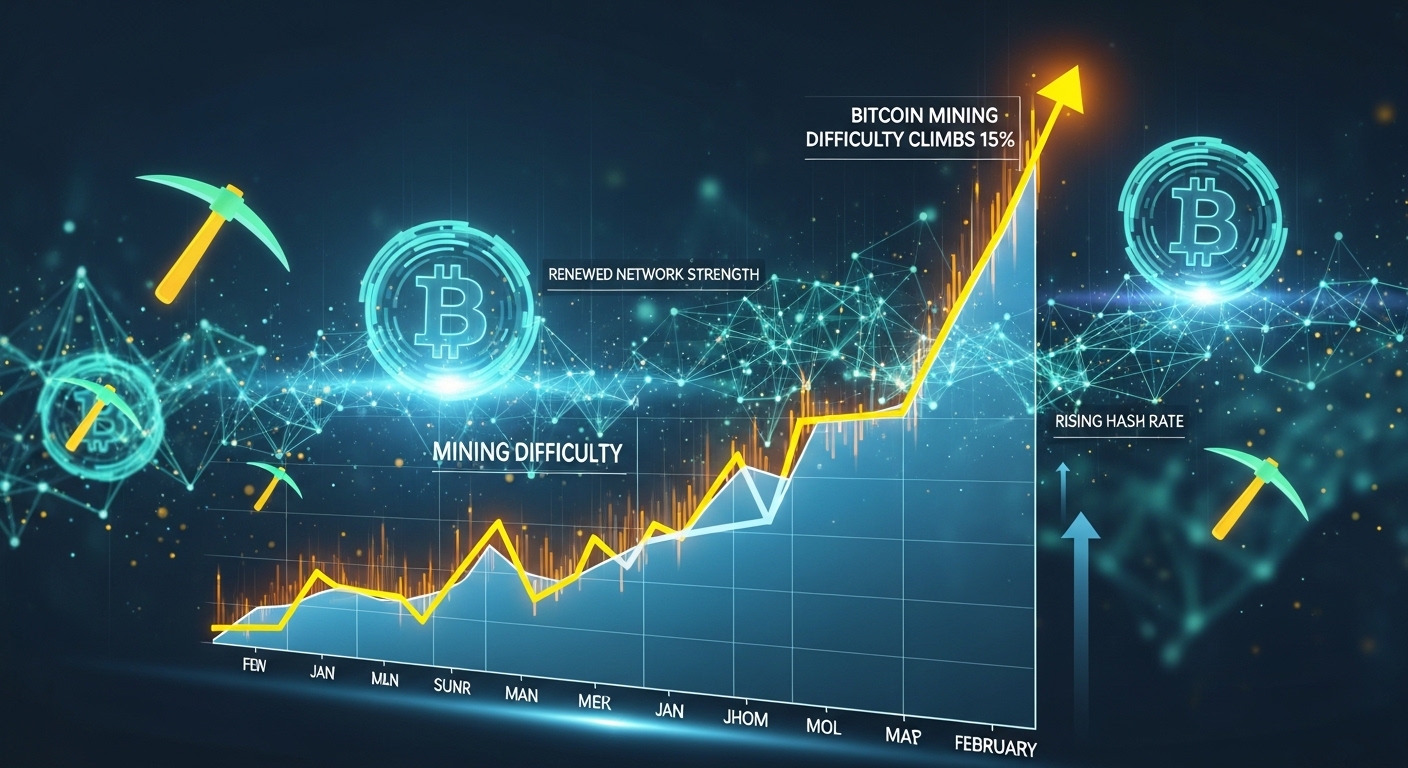
The 15% surge in difficulty signals a strong return of mining power to the network. When Bitcoin mining difficulty climbs 15%, it typically means that miners have reactivated equipment or new participants have entered the space.
Several catalysts may have driven this rebound. A recovery in Bitcoin’s price can restore mining profitability, encouraging operators to power machines back on. Additionally, improvements in mining hardware efficiency and the deployment of next-generation ASICs can significantly increase overall hash rate.
Seasonal factors may also play a role. In some regions, cooler weather reduces cooling costs, making mining more economical. Furthermore, large-scale mining operations often plan expansions strategically, timing them with favorable market conditions.
The result is a sharp rise in total network hash rate, prompting the automatic upward adjustment in mining difficulty.
The Role of Hash Rate in Difficulty Adjustments
When discussing why Bitcoin mining difficulty climbs 15%, it is impossible to ignore the importance of hash rate. The Bitcoin hash rate represents the total computational power dedicated to mining across the network.
A rising hash rate generally indicates increased miner confidence and investment. It suggests that operators believe long-term rewards outweigh short-term costs. When hash rate increases rapidly, the network must raise difficulty to maintain its ten-minute block interval.
This relationship between hash rate and difficulty forms the backbone of the proof-of-work consensus system. It ensures that Bitcoin remains secure, decentralized, and resistant to manipulation.
The recent 15% increase in difficulty likely corresponds to a significant spike in hash rate following February’s temporary contraction.
Impact on Miner Profitability
When Bitcoin mining difficulty climbs 15%, it directly affects miner profitability. Higher difficulty means that miners must expend more computational effort to earn the same block reward. This intensifies competition across the network.
For miners with access to cheap electricity and modern hardware, higher difficulty can still be manageable. These operators often benefit from economies of scale and efficient infrastructure. However, smaller or less efficient miners may struggle under increased pressure.
Mining profitability depends on several variables, including Bitcoin’s market price, electricity costs, hardware efficiency, and network difficulty. If Bitcoin’s price rises in tandem with difficulty, profitability may remain stable or even improve. But if prices stagnate while difficulty climbs, margins can tighten significantly.
The recent 15% surge suggests renewed competition and confidence, but it also underscores the importance of operational efficiency.
Network Security Strengthens
One of the most positive outcomes when Bitcoin mining difficulty climbs 15% is enhanced network security. Higher difficulty implies a higher hash rate, which makes the network more resistant to attacks.
To compromise Bitcoin’s blockchain, an attacker would need to control a majority of the network’s computational power. As hash rate increases, the cost and logistical challenge of such an attack become exponentially greater.
Thus, the difficulty rebound signals not just miner activity but also stronger overall network security. For investors and long-term holders, this is a reassuring development.
The decentralized network becomes more robust as more participants contribute computing power, reinforcing Bitcoin’s position as a secure digital asset.
Market Sentiment and Investor Confidence
When Bitcoin mining difficulty climbs 15% after a sharp February drop, it sends a message to the market. Rising difficulty often reflects optimism among miners, who are typically considered long-term believers in Bitcoin’s value.
Miners invest heavily in infrastructure, hardware, and energy contracts. Their willingness to expand operations indicates confidence in future price appreciation and network growth.
Investor sentiment can also improve in response to rising difficulty. Many analysts interpret difficulty increases as a bullish signal, suggesting strong underlying fundamentals despite short-term price fluctuations.
In this way, mining metrics serve as leading indicators of broader crypto market trends.
Technological Advancements in Mining Hardware
Another factor contributing to the 15% increase is the deployment of advanced mining equipment. Modern ASIC miners are significantly more efficient than earlier generations. As companies upgrade hardware, total hash rate can surge even if the number of active miners remains stable.
Efficiency improvements reduce the cost per terahash, enabling miners to operate profitably at higher difficulty levels. This technological evolution strengthens the network while increasing competitive pressure.
The integration of cutting-edge chips and improved cooling systems also enhances operational performance. As innovation continues, mining difficulty may trend upward over the long term.
Energy Considerations and Sustainability
Energy usage remains a central topic whenever Bitcoin mining difficulty climbs 15%. Higher difficulty typically correlates with increased energy consumption due to greater computational activity.
However, the industry is increasingly shifting toward renewable and stranded energy sources. Many mining operations now utilize hydroelectric, solar, or wind power to reduce costs and environmental impact.
The push for sustainability is reshaping the narrative around Bitcoin mining. As miners adopt cleaner energy solutions, rising difficulty no longer necessarily equates to greater carbon emissions.
Instead, it may reflect growing investment in sustainable infrastructure within the digital asset ecosystem.
Global Distribution of Mining Power
The rebound in difficulty may also indicate changes in the geographic distribution of mining power. Mining operations continue to expand across North America, Central Asia, and other regions offering favorable energy policies.
Diversification enhances decentralization and reduces reliance on any single jurisdiction. When Bitcoin mining difficulty climbs 15%, it often signals robust global participation rather than localized growth.
This distributed model strengthens the resilience of the network against regulatory or environmental disruptions.
Long-Term Outlook for Mining Difficulty

Historically, Bitcoin mining difficulty has followed an upward trajectory over time, despite periodic corrections. Temporary drops, like the one seen in February, are typically followed by rebounds as miners adapt to new conditions.
As institutional interest grows and technological innovation continues, difficulty adjustments will likely remain dynamic. Future increases may be influenced by macroeconomic factors, regulatory shifts, and advancements in hardware efficiency.
The 15% climb serves as a reminder that the Bitcoin network is self-correcting and adaptive. Its design ensures that equilibrium is restored even after sudden changes in participation.
Broader Implications for the Crypto Industry
When Bitcoin mining difficulty climbs 15% after a sharp February drop, the implications extend beyond miners. Exchanges, investors, and even policymakers monitor mining data to assess network health.
A rising difficulty often reinforces Bitcoin’s narrative as a secure and resilient store of value. It also highlights the competitive nature of blockchain technology, where participants must continually innovate to remain viable.
The rebound may encourage renewed interest in mining stocks and related infrastructure providers, further integrating the mining sector into mainstream financial markets.
Conclusion
The recent surge, in which Bitcoin mining difficulty climbs 15% after a sharp February drop, reflects the resilience and adaptability of the Bitcoin network. What initially appeared to be a slowdown proved to be a temporary recalibration rather than a structural weakness.
Rising hash rate, renewed miner participation, technological advancements, and improving market sentiment all contributed to the rebound. While higher difficulty increases competition and operational demands, it also strengthens network security and reinforces long-term confidence.
As the ecosystem evolves, mining difficulty will continue to fluctuate in response to economic and technological forces. Yet each adjustment underscores the robustness of Bitcoin’s design, ensuring stability and fairness within a decentralized global system.
FAQs
Q: Why did Bitcoin mining difficulty climb 15% after February’s drop?
Bitcoin mining difficulty climbed 15% primarily because the network’s hash rate increased significantly after a temporary decline. When miners returned online or new hardware was deployed, the total computational power rose sharply. The protocol automatically adjusted difficulty upward to maintain consistent block times. This mechanism ensures network stability and reflects renewed miner confidence and profitability conditions.
Q: How does a 15% increase in mining difficulty affect miners?
A 15% increase in mining difficulty means miners must perform more computational work to earn rewards. This can reduce profit margins, especially for operations with high electricity costs or outdated equipment. However, miners with efficient hardware and access to affordable energy can remain competitive. Ultimately, profitability depends on Bitcoin’s price, operational efficiency, and market conditions.
Q: Is rising mining difficulty a bullish sign for Bitcoin?
Rising mining difficulty is often viewed as a bullish indicator because it signals increased participation and stronger network security. When miners invest more resources into the network, it suggests long-term confidence in Bitcoin’s value. While not a direct price predictor, higher difficulty typically reflects healthy underlying fundamentals within the ecosystem.
Q: Does higher mining difficulty mean greater energy consumption?
Higher mining difficulty often correlates with increased energy use because more computational power is involved. However, many mining operations are transitioning toward renewable energy sources. As a result, rising difficulty does not automatically translate to higher carbon emissions. The industry’s focus on sustainability is gradually reshaping its environmental impact.
Q: Can mining difficulty drop again after this increase?
Yes, mining difficulty can decrease if the network’s hash rate falls. If miners shut down operations due to price declines or regulatory pressures, the protocol will adjust difficulty downward during the next adjustment period. This flexibility is built into Bitcoin’s design and ensures that block production remains consistent despite changing participation levels.