
Bitcoin mining and the broader cryptocurrency market have just witnessed a dramatic twist as Bitcoin miner Bitdeer dumps entire BTC reserves, bringing its corporate Bitcoin holdings down to zero in an unprecedented move. This bold decision has sent waves through the industry, sparking speculation, analysis, and strategic debates among investors, analysts, and enthusiasts. In this detailed article, we unpack the full story behind Bitdeer’s liquidation of its Bitcoin treasury, explore the motivations and possible consequences of this move, and explain what it could mean for the miner itself and the broader Bitcoin ecosystem.
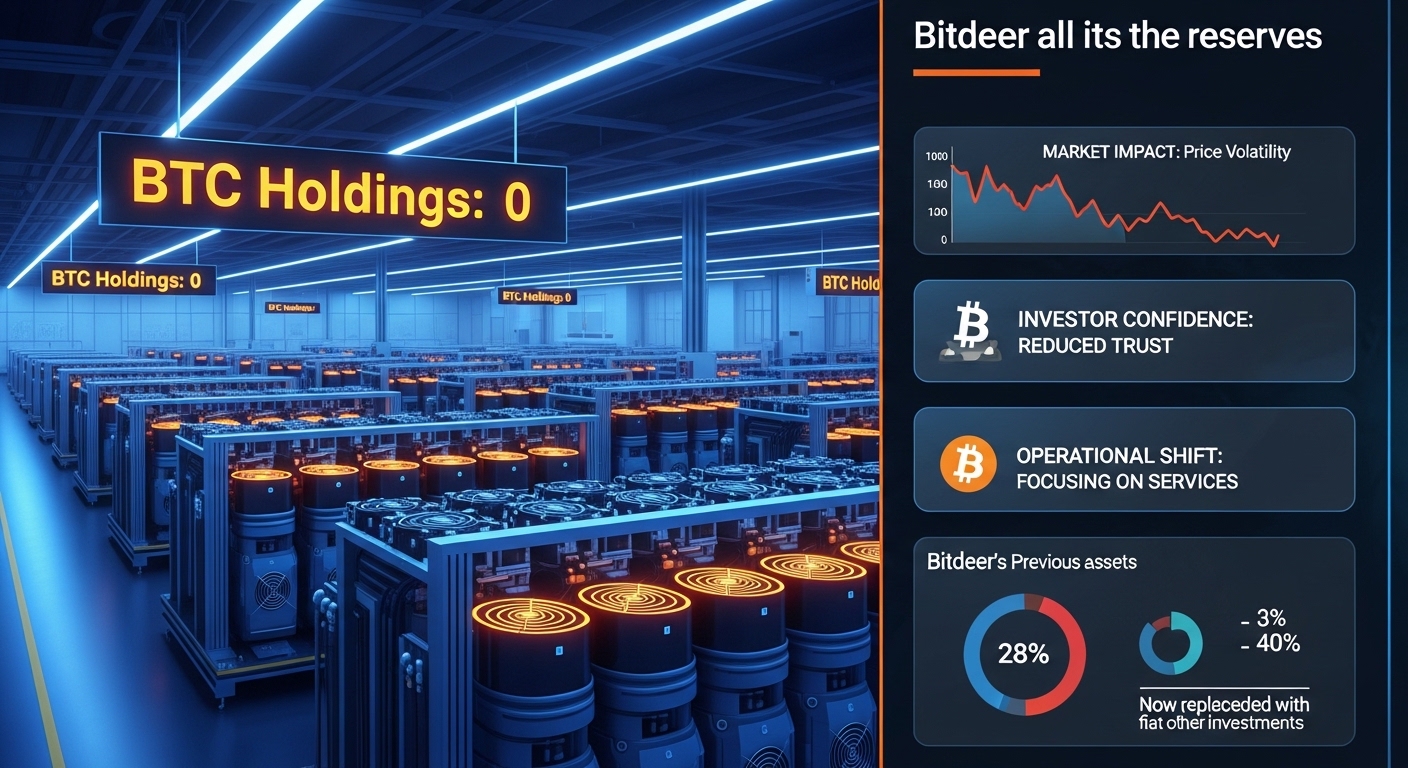
The news that Bitdeer sold all of its Bitcoin holdings — including Bitcoin it mined this week — emerged alongside reports that its total on‑chain BTC balance, excluding customer deposits, fell to zero as of February 20, 2026. This includes selling 189.8 BTC that was mined but not retained, leading to an overall net outflow of 943.1 BTC in just one week.
As with any significant shift in strategy from a major player in the mining space, this event raises important questions: why would a major Bitcoin mining company eliminate its reserves, what are the implications for Bitdeer’s financial health and operational strategy, and what impact might this have on market sentiment and future mining behavior? Let’s dive deeper.
Understanding Bitdeer’s Decision to Sell All BTC
In the recent update from Bitdeer, the company reported that it no longer holds any Bitcoin on its balance sheet, aside from what clients have deposited. This means that every Bitcoin mined by Bitdeer up to February 20, 2026 was sold rather than added to its corporate treasury.
Traditionally, many mining companies adopt a “HODL” strategy — holding onto a portion of the Bitcoin they mine in anticipation of price appreciation over time. Holding BTC on the balance sheet has served as a store of value for firms like Marathon Digital and other public miners. However, Bitdeer’s latest disclosure signals a significant strategy pivot from accumulating BTC reserves toward liquidating those holdings to support operational priorities.
This decision may reflect broader pressures facing the mining industry, particularly in the wake of the Bitcoin halving event that sharply reduced block rewards in mid‑2024 and has squeezed profit margins. With mining yield now lower, energy and operational costs higher, and capital expenditure increasing due to competition in hashrate scale, many miners have been choosing to convert mined Bitcoin into cash in order to fund operations, expansion, or debt servicing.
Strategic Motivations Behind the Dump
One of the most obvious motivations behind Bitdeer’s sale of all Bitcoin holdings is liquidity generation. By converting mined BTC into fiat or stable assets, Bitdeer improves its cash position, which can be critical for meeting operating costs, powering expansion initiatives, and financing new infrastructure.
In fact, just days before the BTC reserves hit zero, Bitdeer priced a US$325 million convertible senior notes offering. This debt instrument provides the company with fresh capital that can be deployed toward growth in AI cloud services, data center expansion, and other strategic priorities.
Liquidating Bitcoin reserves can also help mitigate market risks. Crypto prices are notoriously volatile, and a large accumulation of Bitcoin on the balance sheet exposes firms to price swings that can drastically impact financial results. By selling its holdings, Bitdeer may be aiming to hedge against market downturn risks and stabilize its financial base, rather than be overleveraged in an asset that could quickly depreciate.
Another factor is the shift in how Bitdeer positions itself in the broader technology landscape. While it remains a major Bitcoin mining firm, the company has increasingly emphasized AI infrastructure and cloud computing services. Allocating financial resources toward high‑performance computing and data centers could potentially offer steadier revenue streams compared to speculative crypto holdings.
The Broader Bitcoin Mining Landscape
Bitdeer is not the first miner to trim its Bitcoin reserves. Many miners have sold BTC to cover operational costs or to bolster balance sheets amid market conditions that have been challenging for the sector. Over recent months, leading miners have faced pressure on their stock prices, and broader crypto market volatility has made holding large Bitcoin treasuries less attractive for risk‑averse stakeholders.
However, Bitdeer’s liquidation of its entire Bitcoin holdings stands out for its scale and symbolic significance. While some peers hold substantial reserves to benefit from long‑term price gains, Bitdeer is essentially resetting its treasury to zero. This has prompted conversations about whether long‑term accumulation or near‑term monetization is the smarter approach in the current phase of the crypto cycle.
One side of the debate argues that holding BTC is a strategic advantage. Bitcoin’s historical trend of long‑term price appreciation means that reserves can act as a hedge and source of value that outperforms many traditional assets. On the other hand, advocates for active selling note that miners have high capital and operating expenses, especially with increased global competition for cheap power and efficient hardware. Converting Bitcoin to cash can help sustain growth and fund new projects when price trends are uncertain.
Financial Implications for Bitdeer
The financial implications of selling all BTC vary depending on Bitdeer’s internal cost structures, prices at the time of sale, and broader market conditions. If Bitcoin was sold at historically high prices, this might translate into significant operational liquidity. Conversely, if sales occurred while prices were depressed, the company may not realize maximum value from mined BTC.
Still, moving to zero BTC holdings eliminates exposure to further Bitcoin price declines, which can protect the company’s balance sheet from future volatility. It also allows Bitdeer to focus on PCI (Power, Cloud, Infrastructure) business segments that might deliver steadier performance.
Investors’ reactions to this strategy have been mixed. Notably, when Bitdeer announced its convertible note offering, its stock experienced a downturn of around 17 %, reflecting market apprehension about debt issuance and potential dilution.
Operational and Market Considerations
Beyond finance, Bitdeer’s decision reflects evolving operational priorities. Selling mined Bitcoin rather than holding it frees up capital for high‑growth areas such as accelerating deployments of next‑generation mining hardware, expanding data center facilities, and investing in AI cloud services.
Importantly, the company’s self‑managed hashrate — a measure of its raw mining power — continues to grow, and recent reports indicate that Bitdeer’s self‑mining capacity now surpasses some major competitors. This suggests the firm remains focused on expanding production capabilities even as it revises treasury strategy.
This approach puts Bitdeer in a unique position compared to peers. It prioritizes operational capacity and diversification rather than reliance on Bitcoin price appreciation to deliver financial performance. In a market where macro factors like interest rates, institutional investment flows, and regulatory developments play a significant role, such diversification might be a hedge against industry‑wide turbulence.
Risks and Potential Challenges

No strategic decision comes without risk. One key challenge for Bitdeer’s all‑out selling strategy is timing. If Bitcoin enters a strong bull run, the company may miss potential gains by having zero holdings during a price surge. This could disappoint investors who favor accumulation and position Bitdeer differently in the mining valuation landscape.
There is also the risk that selling large volumes of BTC could dampen market sentiment. Though miners actively selling Bitcoin is not entirely unusual, a high‑profile firm liquidating reserves entirely could be interpreted as a bearish signal by some market participants — potentially influencing short‑term price action and sentiment.
On the operational side, focusing heavily on areas like AI cloud and data centers requires heavy capital investment and technological expertise. The transition from mainly Bitcoin mining revenue to diversified tech services entails execution risk and competition from established cloud and infrastructure players.
What This Means for Bitcoin and the Crypto Market
The news that Bitdeer dumped its entire BTC reserves adds to ongoing narratives about how mining companies are managing assets in the current cycle. It may encourage other miners to reassess their strategies, particularly those weighing the benefits of holding Bitcoin versus converting it for operational liquidity.
This development also highlights how market volatility, costs associated with mining infrastructure, and broader economic conditions influence how miners behave. Mining firms are increasingly at a crossroads where capital deployment, technology expansion, and financial strategy intersect in complex ways.
From the perspective of the Bitcoin ecosystem, miner sales themselves do not always directly translate to market sell pressure equivalent to their sale volume, especially if sales occur gradually or via OTC channels. However, major miners liquidating reserves on a large scale could contribute to increased supply in the market, which might influence price dynamics short‑term.
Long‑Term Outlook for Bitdeer and Bitcoin Miners
Looking ahead, Bitdeer’s decision to build liquidity and reinvest in infrastructure and diversified services might pay off if its expansion into AI cloud services and data center growth gains traction. Technologies that unlock new revenue streams outside of direct Bitcoin price exposure could provide strategic resilience.
For Bitcoin miners more broadly, this episode underscores the importance of adaptive treasury management strategies that align with changing market environments. Some firms may continue to accumulate reserves, anticipating long‑term Bitcoin price appreciation. Others may prioritize monetization and capital allocation toward growth.
Ultimately, miners that strike a balance between operational expansion and prudent financial management are likely to thrive in an industry where energy costs, government policy, and technological advances constantly reshape competitive landscapes.
Conclusion
The move by Bitdeer to sell all its Bitcoin holdings and reduce corporate BTC reserves to zero represents a bold departure from traditional mining treasury strategies. By liquidating its cryptocurrency assets, Bitdeer is prioritizing liquidity, operational flexibility, and investment in growth areas like AI cloud and data center infrastructure. While this strategy may shield the company from Bitcoin price volatility and provide fresh capital, it also carries the opportunity cost of missing out on potential gains if BTC prices rise sharply. As the mining industry continues to evolve, Bitdeer’s decision offers a revealing case study in how miners are navigating financial pressures, growth ambitions, and shifting market dynamics.
FAQs
Q: Why did Bitdeer choose to dump all of its Bitcoin holdings and reduce its BTC reserves to zero rather than holding onto them?
Bitdeer’s choice to liquidate all of its Bitcoin holdings is driven by a combination of factors that include the need for increased liquidity to fund operations and expansion, hedging against market volatility, and shifting its focus toward diversified technology segments such as AI cloud infrastructure. Selling its BTC reserves allows the company to convert mined Bitcoin into working capital, reducing exposure to price fluctuations and supporting initiatives like data center growth. By reducing its treasury to zero, Bitdeer may also be aiming to strengthen its financial stability and respond to competitive pressures in the Bitcoin mining industry. (techfocusasia.com)
Q: How might Bitdeer’s selling of all its Bitcoin reserves impact the price of Bitcoin and the broader crypto market?
When a major miner like Bitdeer sells a large quantity of Bitcoin, it can influence market sentiment by signaling that the company prefers liquidity over holding BTC. This may lead some investors to interpret the move as bearish, especially in the short term. However, miner sales do not always translate directly into downward pressure on the Bitcoin price if executed through non‑exchange sales or spread out over time. The broader market impact depends on how other miners respond, the overall demand for Bitcoin, and macroeconomic conditions affecting risk assets like crypto.
Q: What are the potential benefits and risks of Bitdeer’s new strategy focusing on selling mined Bitcoin and investing in AI and data center expansion?
The benefits of Bitdeer’s strategy include enhanced liquidity to support daily operations, ability to fund capital‑intensive projects without relying on Bitcoin price appreciation, and diversification into technology sectors that complement mining revenue. These moves could position Bitdeer for broader long‑term growth beyond mining alone. Risks include missing out on potential high returns from holding Bitcoin if prices rise significantly, execution challenges in new business areas, and investor concerns over changing core strategy.
Q: Does Bitdeer’s move mean that all Bitcoin miners will start selling their BTC reserves?
Not necessarily. Mining firms adopt different strategies based on their balance sheet health, cost structures, growth priorities, and risk tolerance. Some miners may continue to accumulate Bitcoin as a store of value, especially if they have low energy costs and strong balance sheets. Others may sell portions of their holdings to fund operations. Bitdeer’s move illustrates the spectrum of approaches but does not dictate a universal strategy for all miners.
Q: How can investors interpret Bitdeer’s liquidation of its BTC holdings in terms of the future of the Bitcoin mining industry?
Bitdeer’s decision reflects a larger trend where miners are adapting to reduced block rewards, higher operational costs, and competitive pressures by shifting toward diversified revenue streams and careful treasury management. For investors, this may signal that mining companies are becoming more financially prudent and focused on sustainability. The future of the mining industry may see firms with strong operational efficiency, capital discipline, and technological innovation outperform those relying solely on BTC accumulation.