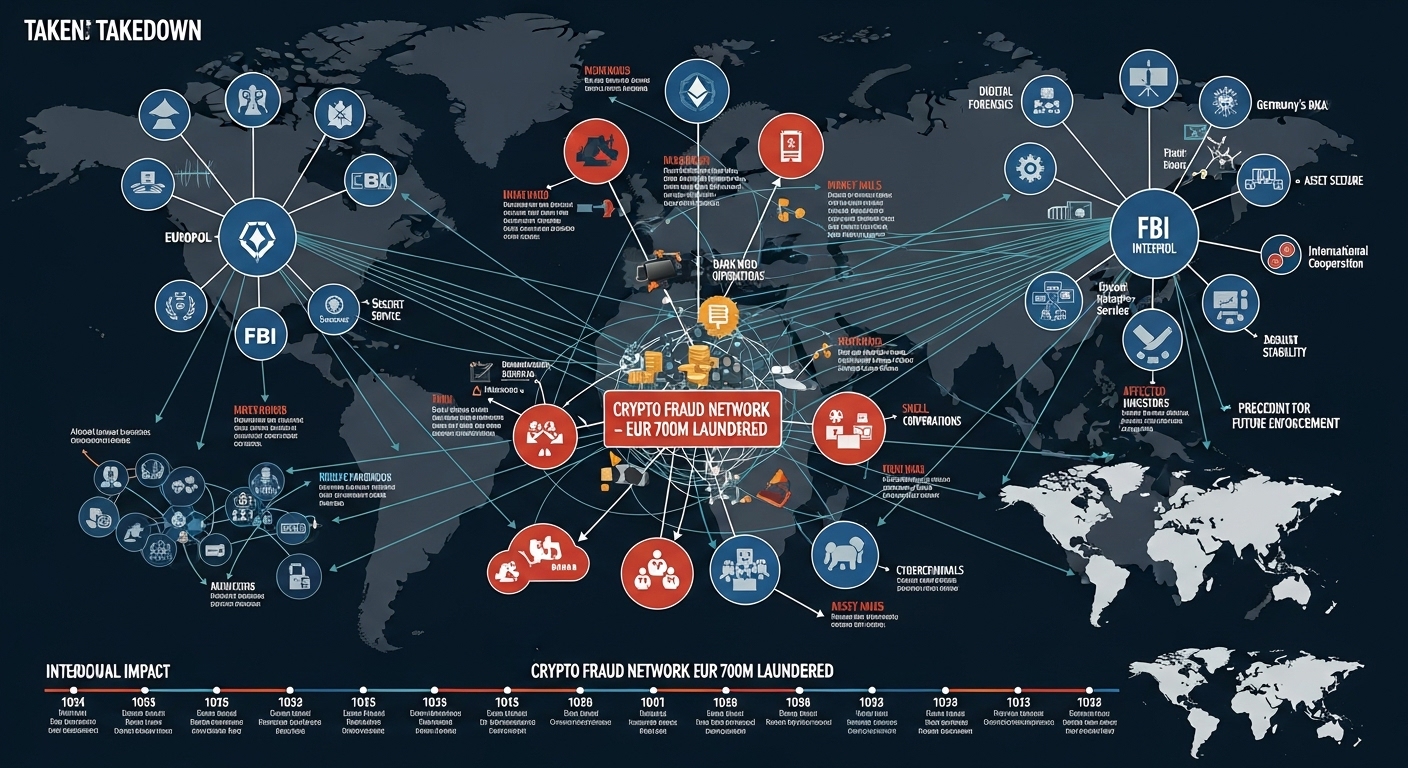
The international takedown of cryptocurrency fraud network laundering over EUR 700 million marks one of the most significant global enforcement actions in the digital asset era. As cryptocurrencies continue to reshape global finance, they have also attracted sophisticated criminal enterprises seeking to exploit decentralized systems for illicit gain. This large-scale crackdown highlights the growing coordination between international law enforcement agencies, financial intelligence units, and cybersecurity experts in combating cross-border financial crime.
The case revolves around an elaborate web of shell companies, digital wallets, fraudulent investment platforms, and complex money laundering mechanisms that processed more than EUR 700 million in illicit funds. Authorities from multiple jurisdictions worked in concert to dismantle the infrastructure behind the scheme, seizing assets, arresting suspects, and disrupting online platforms used to deceive thousands of victims worldwide. The international takedown of cryptocurrency fraud network laundering over EUR 700 million is not only a law enforcement victory but also a signal to criminals that the era of unchecked digital fraud is rapidly narrowing.
The global response to this operation reflects broader efforts to strengthen crypto regulation, enhance anti-money laundering compliance, and modernize financial crime investigations in a rapidly evolving digital economy.
Understanding the Scale of the Cryptocurrency Fraud Network
The cryptocurrency fraud network that laundered over EUR 700 million operated through a sophisticated ecosystem of online deception and financial manipulation. Victims were lured into fraudulent trading platforms promising high returns through digital asset investments, automated crypto trading bots, and so-called exclusive blockchain projects. These platforms often mimicked legitimate exchanges, complete with fabricated trading dashboards and fake profit metrics.
Behind the scenes, funds deposited by investors were immediately redirected into controlled cryptocurrency wallets. Through layered transactions across multiple blockchains, including Bitcoin and Ethereum networks, the criminals obscured the origin of the funds. This tactic, known as crypto layering, is a common method in modern blockchain-based money laundering.
The international takedown of cryptocurrency fraud network laundering over EUR 700 million uncovered a web of intermediaries who facilitated transfers across jurisdictions. The operation relied on decentralized finance tools, peer-to-peer exchanges, and mixing services to complicate tracing efforts. However, advances in blockchain analytics technology allowed investigators to follow the digital trail, linking wallets to real-world identities.
How the Fraud Network Attracted Victims
The success of the cryptocurrency fraud network laundering over EUR 700 million was largely due to its sophisticated social engineering strategies. Fraudsters leveraged social media platforms, messaging apps, and even professional networking sites to build credibility. They created fake testimonials, impersonated financial advisors, and posed as experienced crypto traders.
In many cases, victims were introduced to the scheme through so-called romantic investment scams, often referred to as pig butchering scams. In these schemes, perpetrators built emotional relationships with victims before persuading them to invest large sums into fraudulent cryptocurrency platforms. The psychological manipulation was deliberate and prolonged, making victims more likely to trust the criminals.
The international takedown of cryptocurrency fraud network laundering over EUR 700 million revealed that thousands of individuals across Europe, Asia, and North America were targeted. Losses ranged from small savings accounts to life-altering sums that wiped out retirement funds.
The Mechanics of Laundering EUR 700 Million in Cryptocurrency
Laundering over EUR 700 million through cryptocurrency required advanced technical coordination. Unlike traditional financial systems, blockchain networks record transactions publicly. However, pseudonymity allows criminals to hide behind wallet addresses. To bypass detection, the fraud network relied on several techniques.
First, they employed cryptocurrency mixers and tumblers to break the transaction trail. These services blend funds from multiple users, making it difficult to trace the original source. Second, they utilized cross-chain swaps, transferring assets between different blockchain networks to further fragment the audit trail. Third, they converted digital assets into privacy-focused coins before cashing out through offshore exchanges.
The international takedown of cryptocurrency fraud network laundering over EUR 700 million demonstrated that even complex crypto laundering schemes can be unraveled. Through collaborative intelligence sharing, authorities mapped transaction flows and identified choke points where criminals converted crypto into fiat currency.
The Role of Shell Companies and Offshore Structures

A critical component of the cryptocurrency fraud network laundering over EUR 700 million was its use of shell corporations registered in loosely regulated jurisdictions. These entities opened bank accounts, processed payments, and provided a veneer of legitimacy to fraudulent operations.
By combining traditional money laundering tactics with digital asset transfers, the network created a hybrid laundering model. Funds moved from victims’ bank accounts into shell companies, were converted into cryptocurrency, shuffled across multiple wallets, and eventually reintegrated into the formal financial system.
The international takedown of cryptocurrency fraud network laundering over EUR 700 million exposed how criminal groups exploit regulatory gaps between countries. The lack of harmonized global crypto compliance standards allowed the network to operate across borders for years before being dismantled.
International Cooperation Behind the Takedown
The international takedown of cryptocurrency fraud network laundering over EUR 700 million was made possible through unprecedented collaboration among global enforcement agencies. Organizations such as Europol and national cybercrime units coordinated investigative efforts, pooling intelligence and technical expertise.
Advanced digital forensics and blockchain tracing tools played a central role in identifying suspects. Investigators conducted simultaneous raids across multiple countries, seizing servers, digital wallets, and luxury assets purchased with illicit funds.
This operation underscores the growing recognition that cryptocurrency crime cannot be tackled in isolation. Cross-border fraud demands cross-border solutions. The international takedown of cryptocurrency fraud network laundering over EUR 700 million represents a new benchmark for international enforcement cooperation.
Asset Seizures and Arrests
Authorities seized millions in cryptocurrency, froze bank accounts, and confiscated high-value properties linked to the fraud network. Arrests were made in several jurisdictions, disrupting the leadership structure of the criminal organization.
The international takedown of cryptocurrency fraud network laundering over EUR 700 million also included coordinated efforts to notify victims and provide support for recovery claims. While full restitution may not be possible in all cases, the seizure of digital assets increases the likelihood of partial compensation.
Impact on the Cryptocurrency Industry
The international takedown of cryptocurrency fraud network laundering over EUR 700 million has significant implications for the broader digital asset ecosystem. While cryptocurrency technology itself is neutral, incidents of large-scale fraud damage public trust.
Exchanges and service providers are now under increased pressure to enhance Know Your Customer procedures, strengthen AML compliance frameworks, and adopt advanced monitoring tools. Regulators are accelerating efforts to implement stricter oversight for virtual asset service providers. The case also highlights the importance of investor education. As crypto adoption grows, new participants must understand the risks of unverified platforms and unrealistic profit promises.
Strengthening Regulatory Frameworks
Governments worldwide are tightening crypto regulations in response to high-profile fraud cases. The international takedown of cryptocurrency fraud network laundering over EUR 700 million reinforces the need for consistent regulatory standards across jurisdictions. Enhanced reporting requirements, mandatory identity verification, and improved transaction monitoring systems are becoming standard. These measures aim to prevent similar networks from exploiting loopholes in the future.
Lessons for Investors and Financial Institutions

The international takedown of cryptocurrency fraud network laundering over EUR 700 million provides critical lessons for both investors and institutions. Investors must verify the legitimacy of platforms, avoid guaranteed return promises, and conduct due diligence before transferring funds.
Financial institutions should integrate real-time blockchain monitoring systems to detect suspicious patterns. Collaboration between banks and crypto exchanges is essential to intercept illicit flows early. This case illustrates that while cryptocurrency offers innovation and financial inclusion, it also demands heightened vigilance.
The Future of Crypto Crime Enforcement
The international takedown of cryptocurrency fraud network laundering over EUR 700 million signals a turning point in the fight against digital financial crime. Law enforcement agencies are rapidly enhancing technical capabilities, hiring blockchain specialists, and leveraging artificial intelligence for transaction analysis.
Criminal networks may continue to evolve, but so too will investigative methods. The integration of machine learning analytics and cross-border intelligence databases will likely make future fraud networks easier to detect.
As cryptocurrency becomes more mainstream, the balance between innovation and regulation will shape the industry’s trajectory. The international takedown of cryptocurrency fraud network laundering over EUR 700 million serves as both a warning and a milestone in this ongoing transformation.
Conclusion
The international takedown of cryptocurrency fraud network laundering over EUR 700 million represents a landmark achievement in global financial crime enforcement. By dismantling a complex web of fraudulent investment schemes and money laundering operations, authorities have demonstrated that digital anonymity does not guarantee impunity. This operation underscores the importance of international cooperation, regulatory reform, and technological innovation in combating crypto-related crime. As the digital asset landscape continues to evolve, proactive measures and informed participation will be essential to ensuring a secure and trustworthy financial ecosystem.
FAQs
Q: What made the international takedown of cryptocurrency fraud network laundering over EUR 700 million so significant?
The international takedown of cryptocurrency fraud network laundering over EUR 700 million stands out because of its scale, complexity, and level of global coordination. Laundering over EUR 700 million through digital assets required advanced technical infrastructure and cross-border organization. The case demonstrates that even sophisticated crypto crime networks can be dismantled when law enforcement agencies collaborate effectively and use modern blockchain tracing tools.
Q: How did investigators trace funds in the cryptocurrency fraud network?
Investigators used advanced blockchain analytics and digital forensic techniques to track wallet addresses and transaction flows. Despite the use of mixers and cross-chain swaps, patterns emerged that linked digital wallets to identifiable entities. The transparency of blockchain ledgers, combined with intelligence from financial institutions, allowed authorities to unravel the laundering scheme.
Q: Can victims recover funds after such a cryptocurrency fraud network is dismantled?
Recovery depends on the assets seized and legal processes in different jurisdictions. In the international takedown of cryptocurrency fraud network laundering over EUR 700 million, authorities froze and confiscated significant amounts of digital assets. While full recovery may not be guaranteed, asset seizures improve the chances of partial restitution for victims.
Q: What role did international cooperation play in the takedown?
International cooperation was central to the success of the operation. Since the cryptocurrency fraud network laundering over EUR 700 million operated across multiple countries, coordinated intelligence sharing and synchronized enforcement actions were necessary. Joint investigations ensured that suspects could not exploit jurisdictional boundaries to evade arrest.
Q: How can investors protect themselves from cryptocurrency fraud networks?
Investors should conduct thorough due diligence before investing in any cryptocurrency platform. Avoiding guaranteed returns, verifying regulatory registration, and using reputable exchanges are essential precautions. Education about common scam tactics, including social engineering and fake trading platforms, can significantly reduce the risk of becoming a victim of large-scale cryptocurrency fraud networks.