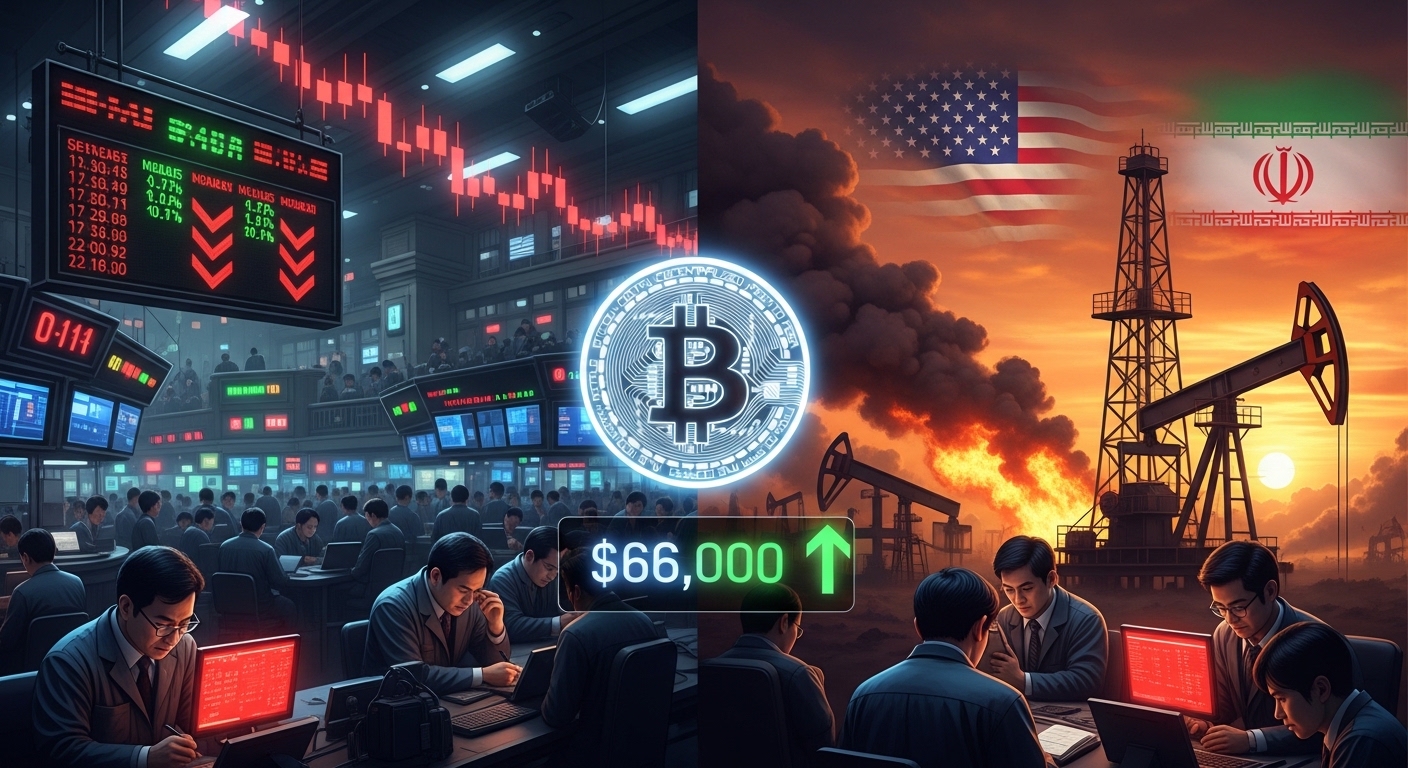
In a world where geopolitical tensions continue to reshape financial markets, Bitcoin remains remarkably resilient, holding near the $66,000 level while global equity markets wobble and commodity prices surge. The complex interplay between geopolitical risk, investor sentiment, and macroeconomic shifts has placed Bitcoin in the spotlight as traders and long‑term holders watch developments unfold. Asian stocks have experienced a meaningful retreat as risk assets are repriced in the face of the escalating conflict between the United States and Iran, while oil prices have spiked to multi‑month highs, reflecting concerns over supply disruptions and broader economic implications. Amid these market gyrations, Bitcoin’s ability to stay relatively firm underscores its dual role as both a speculative asset and a potential hedge in times of global uncertainty.
Investors around the world are closely monitoring how the US‑Iran tensions are influencing financial markets, particularly safe‑haven assets, commodities like oil, and emerging digital assets such as Bitcoin. The cryptocurrency’s performance, regional stock market reactions, and persistent volatility in energy markets paint a vivid picture of how interconnected modern markets have become. The following extended analysis will provide an in‑depth look at Bitcoin’s current price behavior, the factors driving movements in Asian equities, the oil market surge, and what these trends could mean for global investors.
Understanding Bitcoin’s Price Stability Near $66,000
Bitcoin’s ability to hold steady near $66,000, despite mounting pressure across traditional markets, is noteworthy and merits closer inspection. In recent trading sessions, Bitcoin has demonstrated relative calm compared to equities and commodities, reflecting both strong investor interest and growing confidence in the digital asset. This price level is significant for several reasons. First, $66,000 represents a major psychological and technical resistance point that traders have watched for months. Second, this price action comes at a moment of heightened uncertainty, with geopolitical risk weighing heavily on traders’ minds.
In the wake of increased hostilities between the United States and Iran, markets have seen sharp swings. Equity markets in Asia, including the major indices in Japan, China, and South Korea, have experienced declines as investors reallocate capital into safer or alternative assets. In contrast, Bitcoin’s stability near $66,000 suggests that crypto markets may be reacting differently to these same forces. This phenomenon highlights Bitcoin’s evolving role in diversified portfolios and underlines its perceived value beyond purely speculative trading.
Investors who have held Bitcoin through previous price swings are now watching for signals that could anticipate the next major move. The fact that Bitcoin remains around the $66,000 mark demonstrates that demand from institutional and retail investors remains robust. Many market participants view Bitcoin as a hedge against inflation, currency devaluation, and traditional market risk, particularly during times of geopolitical instability.
Why Asian Stocks Are Falling Amid Global Tensions
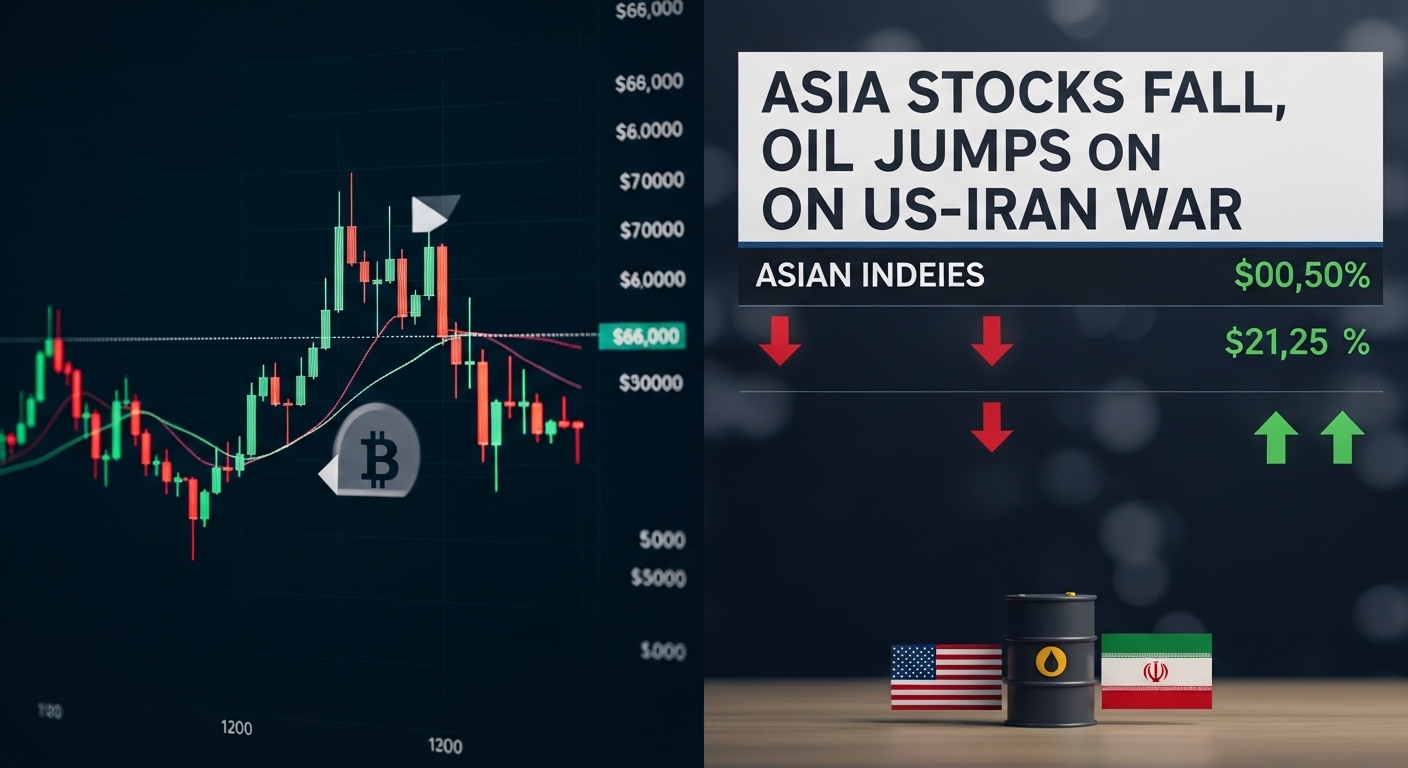
Asian markets have felt the pressure of geopolitical instability, with major indices recording losses as traders reassess risk exposure. The fall in Asian stocks can be attributed to several interconnected factors, all stemming from uncertainty and fear of broader economic consequences. As tensions between the United States and Iran escalate, investors understandably shift away from risk assets, such as stocks, toward safer stores of value or cash.
One reason for the Asian market downturn is the sheer scale of potential economic impact. Asia is heavily reliant on global trade, and any disruptions caused by geopolitical conflict can reduce investor confidence. Rising energy prices, particularly crude oil, increase costs for businesses and consumers alike, potentially slowing growth and corporate earnings. Furthermore, investors fear that conflicts could expand or disrupt global supply chains, prompting capital outflows from equity markets.
Another element driving stock losses in Asia is the correlation between geopolitical risk and currency fluctuations. When risk sentiment deteriorates, investors often seek safe haven currencies, such as the US dollar and Japanese yen. This dynamic can lead to depreciation in regional currencies, putting further pressure on stocks denominated in local currencies. The resulting decline in asset prices can create a feedback loop, where lower stock prices fuel additional selling.
Political uncertainty also plays a role. Governments and central banks in the region may adopt cautious stances in response to escalating tensions, holding back economic initiatives and delaying growth‑oriented policies. This hesitation can translate into weaker market performance as investors lack confidence in near‑term prospects. Regional markets are therefore reacting both to global pressures and local economic concerns.
The Linking of Oil Prices and Geopolitical Conflict
One of the most immediate effects of geopolitical tensions is movement in commodity markets, particularly oil. In recent trading sessions, crude oil prices jumped sharply, driven by fears of supply disruption linked to conflict in the Middle East. Oil markets are incredibly sensitive to perceived risks that could affect production or shipping lanes, especially in regions that are critical to global energy supply.
The Middle East remains a central hub for oil production and export. When conflict threatens stability, traders immediately price in higher risk premiums, which leads to higher crude futures. This reaction is rooted in both speculation and economic fundamentals. If key production facilities or shipping routes are compromised, supply could tighten, forcing prices higher. Even the potential for such outcomes is often enough to trigger price spikes.
Higher oil prices have cascading effects on global economies. For energy‑importing countries, increased prices translate directly into higher fuel costs for consumers and businesses. This can reduce disposable income, increase transportation expenses, and contribute to inflationary pressures. Central banks may then face greater challenges in managing monetary policy, balancing inflation control with economic growth.
The linkage between oil and risk sentiment can also influence other markets. Higher energy prices often coincide with sell‑offs in equities, particularly in sectors sensitive to input costs. Additionally, regional currencies may weaken, exacerbating capital flows out of local markets. In this current environment, the volatility in oil underscores the broader market instability triggered by geopolitical tensions.
Bitcoin as a Perceived Safe Haven in Volatile Times
One of the most intriguing developments in recent market behavior is Bitcoin’s relative calm as traditional assets show increased volatility. Many investors have begun to consider Bitcoin as a potential safe haven asset, similar in concept to gold or certain currencies during periods of stress. While Bitcoin’s history includes significant price swings, its performance in turbulent times has captured the attention of global investors seeking non‑traditional hedges.
Bitcoin’s appeal as a safe haven is rooted in its decentralized nature and limited supply. Unlike fiat currencies subject to inflationary pressures and central bank policies, Bitcoin’s supply schedule is fixed, creating scarcity that appeals to investors wary of monetary easing and currency devaluation. In the context of geopolitical conflict, where confidence in traditional financial systems may wane, Bitcoin’s unique attributes position it as an alternative store of value.
However, it is important to note that Bitcoin’s behavior during times of stress is not uniform. There have been periods when major sell‑offs in equities also pressured crypto markets, driven by liquidity needs and risk aversion. In this current scenario, Bitcoin’s stability near $66,000 suggests that market participants may be treating it differently this time. Institutional investor involvement, increased adoption by large‑scale holders, and the growth of regulated crypto markets have all contributed to more mature market dynamics.
Institutional interest plays a particularly important role in Bitcoin’s resilience. Large investment funds, corporations, and hedge funds have increasingly allocated capital to Bitcoin, viewing it as a strategic long‑term asset. These institutional flows can provide price support during periods of broader market turbulence. Additionally, growing regulatory clarity in various countries has made Bitcoin more accessible to traditional investors, lowering barriers to entry and enhancing liquidity.
How Macro Factors Are Affecting Investment Sentiment
Beyond geopolitical conflict, broader macro economic factors are shaping investor attitudes and asset allocation decisions. Inflation concerns, central bank policies, currency movements, and economic growth forecasts all feed into how investors balance their portfolios. As inflation remains elevated in many regions, and central banks signal uncertainty about future policy direction, risk assets have experienced mixed fortunes.
Investors are increasingly weighing the impact of rising interest rates and slowing economic growth. Higher rates can dampen borrowing and spending, reducing corporate earnings and slowing stock market performance. In contrast, assets like Bitcoin and certain commodities can benefit from perceptions of inflation hedging or scarcity. As the global economy grapples with competing pressures, asset correlations are shifting, creating dynamic investment environments.
Currency markets are another critical influence on investor behavior. When major currencies like the US dollar strengthen, emerging market assets often come under pressure. A stronger dollar can increase debt servicing costs for countries and companies with dollar‑denominated liabilities, prompting risk aversion. Conversely, a weakening dollar may boost commodity prices and certain asset classes, including Bitcoin, which is often priced in US dollars.
Investor sentiment is also shaped by broader economic forecasts and growth expectations. Markets tend to react negatively when growth outlooks deteriorate, and positive when data suggests resilience. In the current environment, ongoing geopolitical risk has injected a layer of uncertainty that complicates forecasting and heightens market sensitivity to new developments. This backdrop creates both challenges and opportunities for investors seeking to navigate volatility and identify potential growth areas.
The Role of Technology and Market Infrastructure in Bitcoin Stability
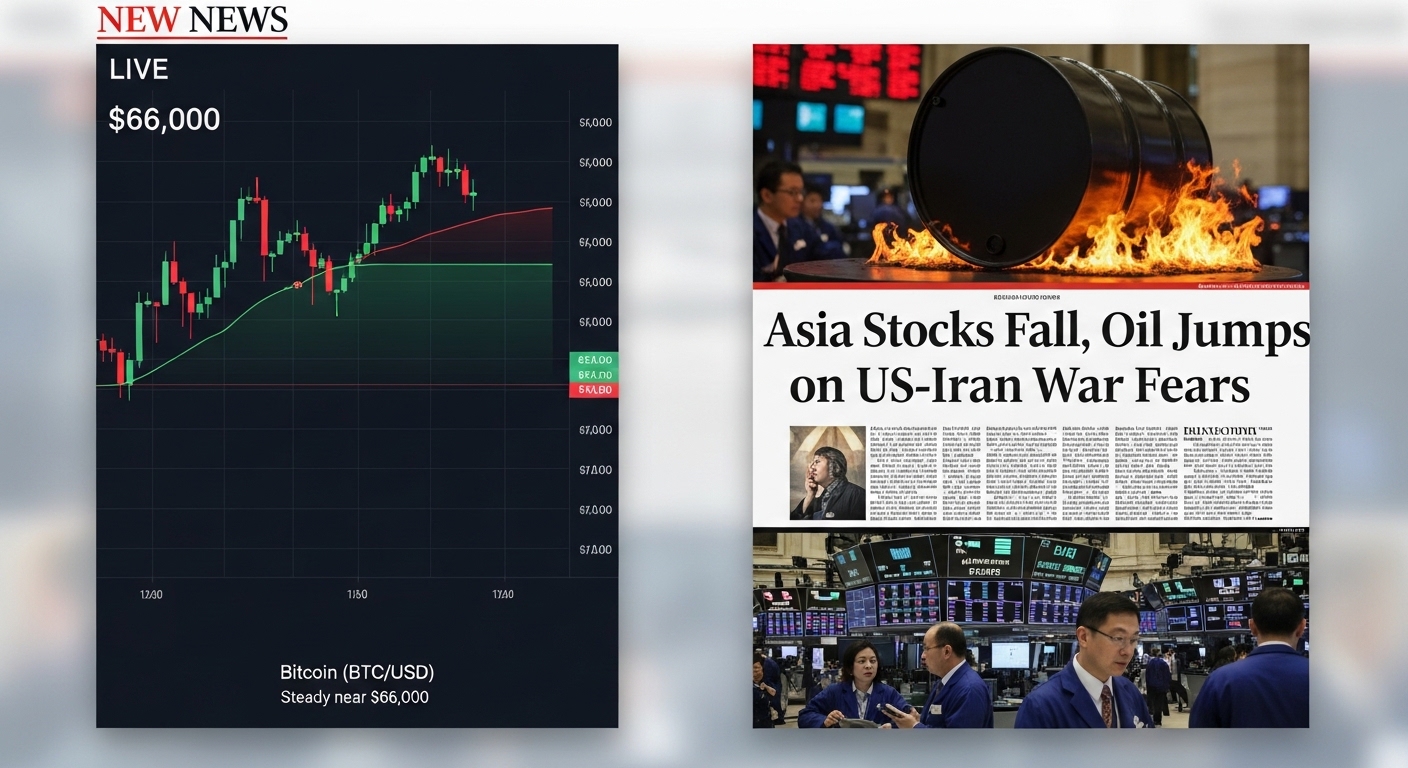
Another important driver behind Bitcoin’s relative stability is the maturation of market infrastructure surrounding cryptocurrencies. Over the past several years, improvements in trading platforms, custody services, institutional products like futures and ETFs, and regulatory frameworks have strengthened the market’s foundation. These developments have increased liquidity, reduced volatility, and expanded access for a wider range of investors.
As large financial institutions have entered the crypto market, they have brought with them risk management practices and trading strategies that can help stabilize prices during turbulent periods. Advanced trading algorithms, arbitrage mechanisms, and deeper order books have all contributed to more orderly markets compared to earlier days of crypto trading. These enhancements mean that Bitcoin can absorb larger trades without as dramatic price swings as seen in the past.
Regulatory clarity, while still evolving, has also played a role. Countries that have established clear rules for crypto trading and investment provide greater confidence to institutional players. This regulatory certainty encourages long‑term investments in Bitcoin and other digital assets. In contrast, markets lacking clear frameworks remain more vulnerable to abrupt regulatory changes, which can trigger rapid price movements.
The development of derivatives markets has also contributed to Bitcoin’s price behaviour. Futures, options, and other financial instruments allow traders to hedge positions, manage risk, and express views on price direction without directly holding the asset. These tools enhance liquidity and create additional layers of market depth, contributing to more stable pricing during periods of stress.
What This Means for Investors Going Forward
For investors watching from near and far, the current market landscape presents a mix of challenges and opportunities. Bitcoin’s steady position near $66,000 suggests that confidence in the cryptocurrency remains strong, even amid broader market turbulence. At the same time, the decline in Asian stocks and the surge in oil prices reflect heightened risk aversion and shifting capital flows.
Investors must consider how to balance exposure across asset classes in a way that aligns with their risk tolerance and long‑term financial goals. Diversification, informed by an understanding of macroeconomic forces and geopolitical risk, is more important than ever. Traditional portfolios comprised only of stocks and bonds may struggle in the face of persistent uncertainty, while alternative assets like Bitcoin and certain commodities could play a complementary role.
Assessing market signals and maintaining flexibility in investment strategies will be key. While Bitcoin has shown resilience this time, crypto markets are inherently volatile and subject to rapid change. Investors should avoid overconcentration in any single asset class and instead focus on balanced portfolios that reflect both current conditions and future prospects.
Monitoring global events, economic data, and policy developments is also essential. The interconnected nature of financial markets means that movements in one region or asset class can have ripple effects across others. A comprehensive view of market dynamics can help investors make more informed decisions and respond effectively to changing conditions.
Conclusion
In a world marked by rising geopolitical tensions, Bitcoin’s steady performance near the $66,000 level stands out against a backdrop of falling Asian stocks and surging oil prices. The volatility seen across traditional markets underscores the complex and interconnected nature of today’s financial landscape. While geopolitical conflict and macroeconomic pressures have driven risk aversion and commodity price spikes, Bitcoin’s resilience highlights its evolving role in diversified investment approaches.
The current market environment emphasizes the importance of understanding the interplay between geopolitics, macroeconomic forces, and investor sentiment. As global markets continue to react to ongoing developments, investors must remain vigilant, informed, and adaptable. Bitcoin’s relative stability and the broader market shifts provide valuable lessons in asset allocation, risk management, and the dynamic nature of financial systems.
FAQs
Q: Why has Bitcoin remained steady near $66,000 despite falling Asian stocks and rising oil prices?
Bitcoin’s relative stability near $66,000 can be attributed to increased investor confidence in its long‑term value proposition, deeper market liquidity, and greater institutional participation. Unlike traditional equities, which are highly sensitive to geopolitical risk and immediate economic concerns, Bitcoin has increasingly been viewed as an alternative store of value. Investors seeking diversification or hedges against inflationary pressures may gravitate toward cryptocurrencies, especially when conventional markets show stress. Additionally, enhanced trading infrastructure, regulatory clarity in certain regions, and mature derivatives markets have contributed to more orderly price behavior in the face of broader market fluctuations. These factors combined help explain why Bitcoin has not mirrored the sharp declines or volatility seen in other asset classes during recent geopolitical tensions.
Q: How do US‑Iran tensions influence global markets, including stocks and commodities?
Geopolitical conflicts such as tensions between the United States and Iran tend to raise uncertainty across global markets, driving investors away from risk assets like stocks and toward safe havens or commodities. Fear of broader conflict, potential disruptions to global supply chains, and the threat of compromised energy exports can all weigh heavily on market sentiment. As a result, Asian stocks have fallen as risk appetite declines, while commodities like oil surge due to concerns about supply constraints, particularly in regions critical to global energy production. Higher oil prices not only reflect immediate geopolitical risk premiums but also feed into broader economic concerns, such as inflation and reduced corporate profitability. These dynamics illustrate how geopolitical conflicts can cascade through various market sectors and asset classes.
Q: In what ways does oil price volatility impact broader economic and financial conditions?
Volatility in oil prices can have far‑reaching consequences across the global economy. As oil is a fundamental input for transportation, manufacturing, and energy production, sharp price increases raise costs for businesses and consumers alike. Higher energy costs contribute to persistent inflationary pressures, which can influence central bank policy decisions, such as raising interest rates to curb inflation. These actions can, in turn, slow economic growth, dampen consumer spending, and weigh on equity markets. For countries that rely heavily on energy imports, elevated oil prices can strain trade balances and depreciate local currencies, further pressuring markets. Thus, oil price volatility is not just a concern for the energy sector but has broad implications for economic stability and financial conditions worldwide.
Q: What role do macroeconomic factors like interest rates and inflation play in shaping investor behavior toward Bitcoin?
Macroeconomic factors significantly influence investor behavior across asset classes, including Bitcoin. High inflation rates often erode the purchasing power of fiat currencies, prompting investors to seek assets that are perceived as hedges against erosion in monetary value. Bitcoin’s fixed supply and decentralized nature position it as a potential inflation hedge in the eyes of some investors. Conversely, rising interest rates can make traditional income‑producing assets more attractive, drawing capital away from risk‑oriented investments such as cryptocurrencies. However, when real interest rates remain uncertain or economic growth forecasts dim, Bitcoin may continue to appeal to investors seeking alternatives to conventional fixed‑income products. Understanding these broader economic influences is crucial for assessing how capital flows into or out of Bitcoin and other assets.
Q: What strategies should investors consider in light of the current market volatility affecting stocks, oil, and Bitcoin?
In the face of significant market volatility, it is essential for investors to adopt diversified strategies that balance risk and opportunity. Diversification across asset classes—such as equities, commodities, fixed income, and digital assets like Bitcoin—can help spread risk and reduce exposure to any single market shock. Investors should also maintain a long‑term perspective, avoiding reactive decisions based solely on short‑term price fluctuations. Staying informed about macroeconomic trends, geopolitical developments, and central bank policies can provide valuable context for investment decisions. Additionally, aligning investment choices with individual risk tolerance, time horizons, and financial goals remains fundamental. By combining informed risk management with disciplined portfolio allocation, investors can better navigate the complex market conditions shaped by geopolitical tensions and economic uncertainties.