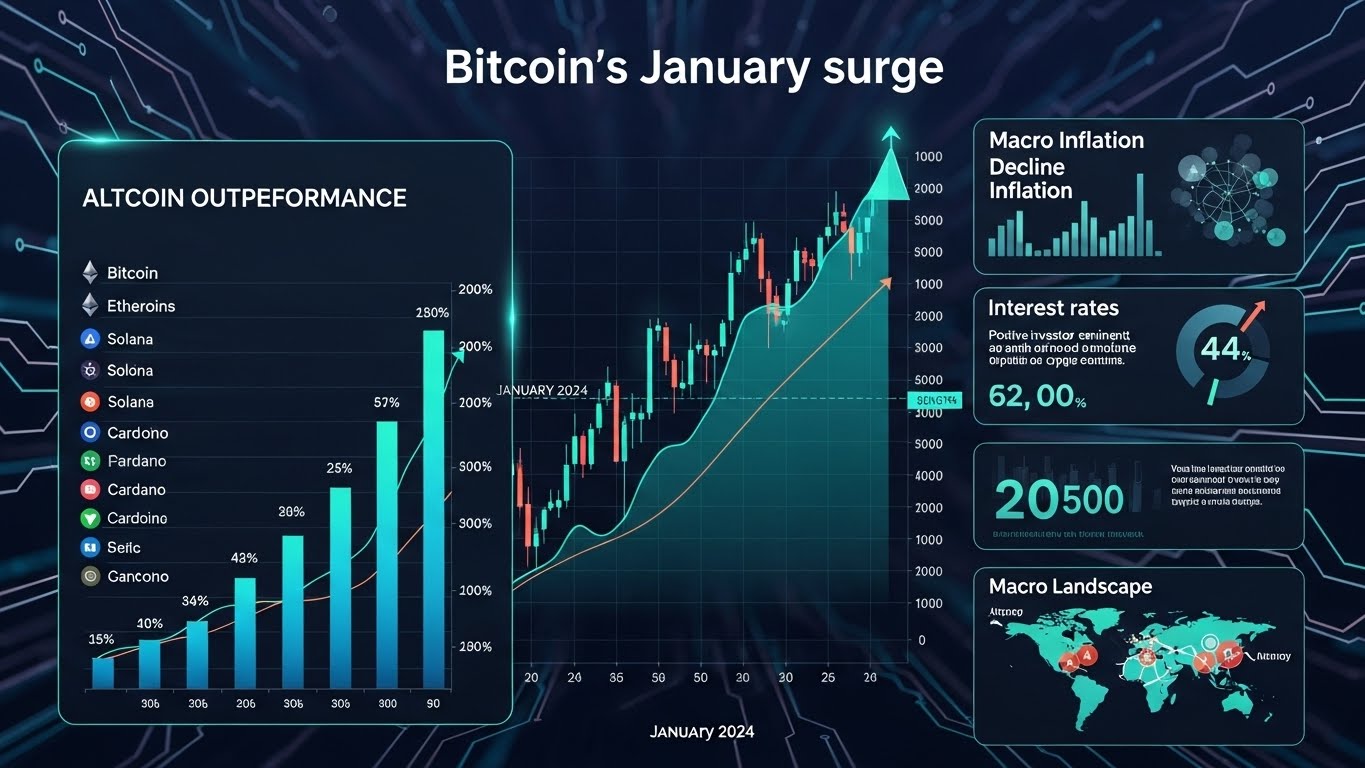
Bitcoin’s January surge has once again placed the world’s largest cryptocurrency at the center of global financial discussions. Historically, January has been viewed as a tone-setting month for digital assets, often shaping market sentiment for the rest of the year. This time, the rally has been driven by a complex mix of technical analysis, renewed altcoin strength, and a shifting macroeconomic environment that continues to redefine risk assets. Investors, traders, and long-term holders are closely watching how Bitcoin’s price behavior aligns with broader financial conditions, including interest rate expectations, liquidity cycles, and institutional participation.
Unlike short-lived speculative spikes, Bitcoin’s January surge shows structural depth. Strong spot demand, improving on-chain metrics, and resilience near key support zones suggest that this move is not purely driven by leverage. At the same time, several altcoins are outperforming Bitcoin on a relative basis, hinting at early-stage rotation within the crypto market. Understanding this phenomenon requires a holistic view that combines chart-based insights with macro fundamentals.
This article explores Bitcoin’s January surge in detail, focusing on critical technical levels, the reasons behind altcoin outperformance, and the broader macro landscape influencing digital assets. By connecting these elements, readers can gain a clearer perspective on where the market stands and what may lie ahead.
Bitcoin’s January Surge in Historical Context
Seasonal patterns and January performance
Bitcoin’s January surge is not an isolated event. Over the years, January has often acted as a reset month following year-end volatility and tax-related selling. Historically, periods of strong January performance have coincided with renewed optimism and fresh capital inflows into crypto markets. While seasonality alone does not guarantee outcomes, it plays a psychological role in shaping expectations.
In previous cycles, January rallies have sometimes marked the continuation of broader uptrends, especially when supported by improving liquidity conditions. Conversely, weak January performance has occasionally preceded extended consolidation phases. The current surge stands out because it is supported by both technical confirmation and macro tailwinds, making it more structurally significant than purely sentiment-driven rallies.
Market maturity and institutional influence
Another distinguishing factor of Bitcoin’s January surge is the maturity of the market. Compared to earlier cycles, Bitcoin now benefits from deeper liquidity, regulated investment vehicles, and increasing institutional participation. These developments reduce the likelihood of extreme price dislocations and enhance the relevance of key technical levels. Institutional investors tend to respect support and resistance zones, reinforcing their importance during periods of heightened volatility.
Technical Levels Defining Bitcoin’s Momentum
Key support zones and demand areas
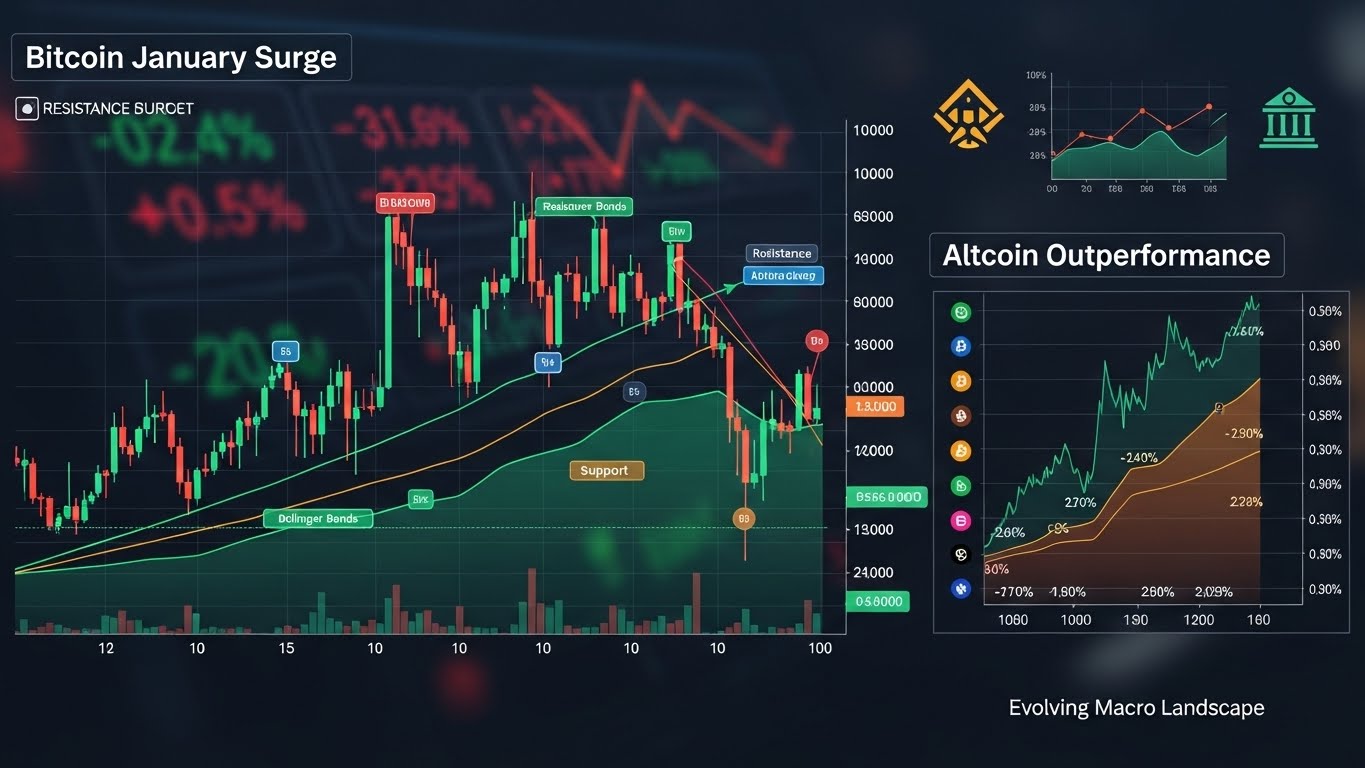
Technical analysis remains central to understanding Bitcoin’s January surge. One of the most critical aspects is the establishment of strong support zones that act as foundations for further upside. These levels often align with previous resistance areas that have now flipped into support, signaling a shift in market structure.
The presence of sustained buying interest near these zones suggests confidence among market participants. From a chart perspective, higher lows forming above long-term moving averages indicate that Bitcoin’s trend remains constructive. Bitcoin price action, when combined with volume analysis, shows accumulation rather than distribution, reinforcing the bullish narrative.
Resistance levels and breakout confirmation
While support provides stability, resistance levels define the market’s upside potential. Bitcoin’s January surge has tested several key resistance zones, with successful breakouts often accompanied by increased spot volume. These breakouts are significant because they confirm strength rather than speculative excess.
In technical terms, clean closes above resistance levels on higher time frames enhance the probability of continuation. This behavior also attracts trend-following strategies, further amplifying momentum. Technical indicators such as relative strength and trend oscillators have supported this move without reaching extreme overbought conditions, suggesting room for further expansion.
Long-term trend structure and moving averages

Beyond short-term levels, Bitcoin’s position relative to long-term moving averages provides critical insight. Sustained trading above these averages often signals a healthy bull phase. During Bitcoin’s January surge, price action has respected these indicators, reinforcing the broader uptrend narrative.
From a structural standpoint, the alignment of short, medium, and long-term trends points to a market that is gradually transitioning from consolidation to expansion. This trend structure is essential for evaluating whether the rally can evolve into a sustained move rather than a temporary spike.
Altcoin Outperformance and Market Rotation
Understanding altcoin strength during Bitcoin rallies
Altcoin outperformance during Bitcoin’s January surge has attracted significant attention. Traditionally, Bitcoin leads market recoveries, with altcoins following once confidence improves. In the current environment, several altcoins are outperforming Bitcoin on a percentage basis, suggesting early-stage market rotation.
This phenomenon often occurs when Bitcoin stabilizes above key levels, reducing perceived risk and encouraging investors to seek higher returns in alternative assets. Altcoin market capitalization growth relative to Bitcoin dominance indicates that capital is flowing into broader segments of the crypto ecosystem.
Sector-specific drivers of altcoin gains
Not all altcoins are performing equally. Sector-specific narratives play a crucial role in determining which assets outperform. Innovations in decentralized finance, scalability solutions, and infrastructure projects have contributed to selective strength across the altcoin market.
These gains are not purely speculative. Many altcoins benefiting from Bitcoin’s January surge are supported by improving fundamentals, such as increased network usage or technological upgrades. This alignment of price action with fundamentals enhances the sustainability of altcoin outperformance.
Implications for investors and traders
Altcoin outperformance during Bitcoin’s January surge has important implications for portfolio allocation. While Bitcoin remains the benchmark asset, selective exposure to high-quality altcoins can enhance returns during periods of rotation. However, increased volatility in altcoins requires disciplined risk management.
From a broader perspective, sustained altcoin strength often signals growing confidence in the crypto market as a whole. This environment tends to attract new participants, further reinforcing liquidity and depth across digital assets.
The Macro Landscape Shaping Bitcoin’s January Surge
Interest rates, liquidity, and risk appetite
The macro landscape plays a pivotal role in shaping Bitcoin’s January surge. Global interest rate expectations, central bank policies, and liquidity conditions directly influence investor behavior. When liquidity improves and rate hike pressures ease, risk assets like Bitcoin tend to benefit.
In the current environment, shifting expectations around monetary policy have contributed to a more favorable backdrop for digital assets. Macroeconomic trends such as moderating inflation and stabilizing growth outlooks have encouraged investors to re-evaluate alternative stores of value.
Bitcoin as a macro-sensitive asset
Bitcoin’s evolution from a niche asset to a macro-sensitive instrument has become increasingly evident. During periods of economic uncertainty, Bitcoin is often viewed through multiple lenses, including as a hedge, a growth asset, and a speculative instrument. Bitcoin’s January surge reflects this multifaceted role.
Correlation dynamics between Bitcoin and traditional assets have fluctuated, highlighting its unique position in global portfolios. As macro conditions evolve, Bitcoin’s responsiveness to these shifts underscores the importance of integrating macro analysis into crypto investment strategies.
Institutional adoption and regulatory clarity
Institutional adoption continues to shape the macro landscape for Bitcoin. Increased participation from asset managers and financial institutions enhances credibility and stability. Regulatory clarity, while still evolving, has reduced uncertainty in key markets, contributing to renewed confidence.
These factors have played a supportive role in Bitcoin’s January surge by encouraging long-term capital allocation rather than short-term speculation. As institutional frameworks mature, Bitcoin’s integration into the broader financial system is likely to deepen.
Interplay Between Technicals, Altcoins, and Macro Factors
Confluence of signals driving momentum
Bitcoin’s January surge is best understood through the confluence of technical, altcoin, and macro signals. Strong technical structures provide the foundation, altcoin outperformance reflects risk appetite, and macro conditions set the broader context.
This alignment creates a feedback loop where positive developments in one area reinforce confidence in others. For example, macro stability supports technical breakouts, which in turn encourage altcoin rotation, further strengthening market sentiment.
Risks and potential headwinds
Despite the constructive outlook, risks remain. Sudden shifts in macro policy, unexpected regulatory developments, or technical breakdowns could disrupt momentum. Understanding these risks is essential for maintaining a balanced perspective.
From a technical standpoint, failure to hold key support levels could signal deeper consolidation. On the macro front, renewed tightening or liquidity constraints could dampen enthusiasm. Awareness of these factors allows investors to navigate Bitcoin’s January surge with greater confidence.
Long-Term Outlook for Bitcoin After January
Sustainability of the current trend
The sustainability of Bitcoin’s January surge depends on continued alignment between technical strength and macro support. If Bitcoin maintains higher lows and consolidates above critical levels, the probability of trend continuation increases. Long-term adoption trends, including infrastructure development and user growth, also play a crucial role. These factors provide underlying demand that can support price appreciation beyond short-term cycles.
Role of altcoins in the broader market cycle
Altcoin outperformance often signals a maturing phase of the market cycle. If this trend persists, it could indicate expanding participation and innovation within the crypto ecosystem. However, Bitcoin is likely to remain the anchor asset, guiding overall market direction. Understanding how altcoins interact with Bitcoin’s trend helps investors position themselves strategically as the market evolves.
Conclusion
Bitcoin’s January surge represents a convergence of strong technical levels, notable altcoin outperformance, and a supportive macro landscape. Rather than being driven by a single factor, this rally reflects a complex interplay of market structure, investor confidence, and global economic conditions. Key support and resistance levels provide insight into momentum, while altcoin strength highlights growing risk appetite and diversification within the crypto market. At the same time, macroeconomic trends, institutional adoption, and evolving liquidity dynamics continue to shape Bitcoin’s role in global portfolios.
As the year progresses, the lessons from Bitcoin’s January surge underscore the importance of a holistic approach to market analysis. By integrating technical, fundamental, and macro perspectives, investors can better navigate volatility and identify opportunities within the evolving digital asset landscape.
FAQs
Q: Why is Bitcoin’s January surge considered significant compared to other rallies?
Bitcoin’s January surge is significant because it combines strong technical confirmation with supportive macro conditions and widespread altcoin outperformance. Unlike short-term spikes driven by speculation, this move shows structural depth through sustained demand, improving market structure, and broader participation across the crypto ecosystem.
Q: How do technical levels influence Bitcoin’s January surge?
Technical levels act as reference points for market participants, guiding buying and selling decisions. During Bitcoin’s January surge, the ability to hold key support zones and break through resistance levels has reinforced confidence and attracted additional capital, supporting trend continuation.
Q: What explains altcoin outperformance during Bitcoin’s January surge?
Altcoin outperformance often occurs when Bitcoin stabilizes above critical levels, reducing perceived risk. Investors then rotate capital into alternative assets seeking higher returns. In the current surge, selective altcoins with strong fundamentals have benefited from this rotation.
Q: How does the macro landscape impact Bitcoin’s price movement?
The macro landscape influences liquidity, risk appetite, and investor sentiment. Factors such as interest rate expectations, inflation trends, and institutional adoption shape demand for Bitcoin. A supportive macro environment has played a key role in sustaining Bitcoin’s January surge.
Q: Can Bitcoin’s January surge set the tone for the rest of the year?
Historically, strong January performance has often set a positive tone for the year, though outcomes are never guaranteed. Bitcoin’s January surge, supported by technical strength and macro alignment, increases the likelihood of constructive market conditions, but ongoing developments will ultimately determine long-term performance.