Energy has always been a story of infrastructure, geopolitics, and scale. For more than a century, the global energy economy has revolved around centralized production, long-distance transmission, regulated monopolies, and large institutions that control pricing and access. In many countries, you can’t choose where your electricity comes from, how it’s priced, or how quickly the system responds when demand spikes. Even as renewable generation expands, the core structure of energy markets still feels like it belongs to the industrial era.
But the modern energy system is changing faster than most people realize. Rooftop solar, battery storage, electric vehicles, smart meters, and microgrids are shifting power generation closer to consumers. In this new landscape, the grid is no longer a one-way pipeline. It’s becoming an interactive marketplace where households, factories, and communities can generate, store, and trade energy. That shift creates an urgent need for systems that can track energy flows, verify transactions, settle payments instantly, and coordinate thousands or millions of participants without relying on a single centralized authority.
This is where blockchain comes in. The idea behind “From Grids to Tokens: How Blockchain Is Rewriting the Global Energy Economy” is not that crypto will replace electricity markets overnight, but that blockchain can solve specific coordination problems that centralized systems struggle with. Blockchain networks can record energy production and consumption transparently, tokenize energy credits or kilowatt-hours into digital assets, automate energy contracts with smart rules, and enable peer-to-peer energy trade with reduced overhead. In short, blockchain is rewriting the global energy economy by turning energy from a purely physical commodity into a digitally tradable, programmable resource.
In this article, we’ll explore how blockchain is rewriting the global energy economy in practical terms. We’ll break down tokenization, peer-to-peer energy trading, grid flexibility, renewable energy certification, carbon accounting, and the role of smart contracts in energy finance. You’ll also learn the barriers, the regulatory reality, and the future outlook as energy markets transition from rigid grids to adaptive token-driven systems.
Why the Global Energy Economy Needs a Rewrite
The global energy economy is under stress from three forces at once: decarbonization, decentralization, and digitization. Decarbonization demands rapid expansion of renewables and lower emissions. Decentralization is happening through distributed energy resources like solar rooftops, wind farms, and home batteries. Digitization is transforming how grids monitor usage and optimize supply.
Yet despite these changes, many energy systems still rely on slow settlement cycles, fragmented data systems, and layers of intermediaries that add costs and friction. Electricity markets are complex because energy must be balanced in real time. A centralized authority typically manages this balancing act, making decisions based on imperfect information and limited flexibility. When that model meets a world of millions of small producers and prosumers, the administrative load becomes enormous.
Blockchain is rewriting the global energy economy because it introduces a shared ledger that can unify data, automate trust, and reduce transaction friction. Instead of relying solely on centralized reconciliation between producers, utilities, traders, and consumers, blockchain can provide a tamper-resistant record of who produced energy, who consumed it, and when the exchange happened. This is especially important for distributed grids where transactions could become too frequent and too small for legacy systems to handle economically.
From Grids to Tokens: What Tokenization Means in Energy
Tokenization is the process of turning a real-world asset or unit of value into a digital token that can be stored, transferred, and traded on a blockchain. In energy, tokenization can represent electricity itself, renewable energy attributes, grid services, or even future production rights.
The most intuitive example is tokenizing a kilowatt-hour. Instead of simply billing you at the end of the month, a system could represent each unit of electricity as a token that moves from producer to consumer at the time of consumption. This creates the foundation for real-time settlement, dynamic pricing, and transparent energy provenance.
Tokenization also supports renewable markets. A renewable energy producer could tokenize clean energy certificates, allowing buyers to verify renewable sourcing instantly. In many markets today, renewable certificates are tracked through centralized registries that can be slow and opaque. Tokenized certificates could reduce paperwork, improve transparency, and make smaller renewable projects economically viable in certificate markets. When tokenization becomes mainstream, blockchain is rewriting the global energy economy by enabling energy to function like a digital commodity, traded efficiently at small scale and across borders with fewer intermediaries.
How Smart Contracts Are Powering the New Energy Economy
Smart contracts are automated programs that run on blockchain networks. They can execute agreements without manual intervention as long as predefined conditions are met. In the energy sector, smart contracts can simplify complex workflows that currently require brokers, auditors, and settlement systems.
A smart contract could automatically pay a solar producer when energy is delivered to the grid. It could adjust the price based on real-time demand, time-of-use tariffs, or carbon intensity. It could also enforce compliance rules, such as limiting trades to verified participants or ensuring renewable claims match verified generation.
This automation matters because energy markets involve frequent transactions, often with thin margins. Cutting administrative overhead improves efficiency and unlocks business models that don’t work with traditional billing cycles. Smart contracts also enable dynamic pricing, allowing consumers to respond to price signals automatically, which improves grid stability. When smart contracts become widely adopted, blockchain is rewriting the global energy economy by replacing slow, trust-heavy settlement systems with programmable, instant execution.
Peer-to-Peer Energy Trading and the Rise of Prosumers
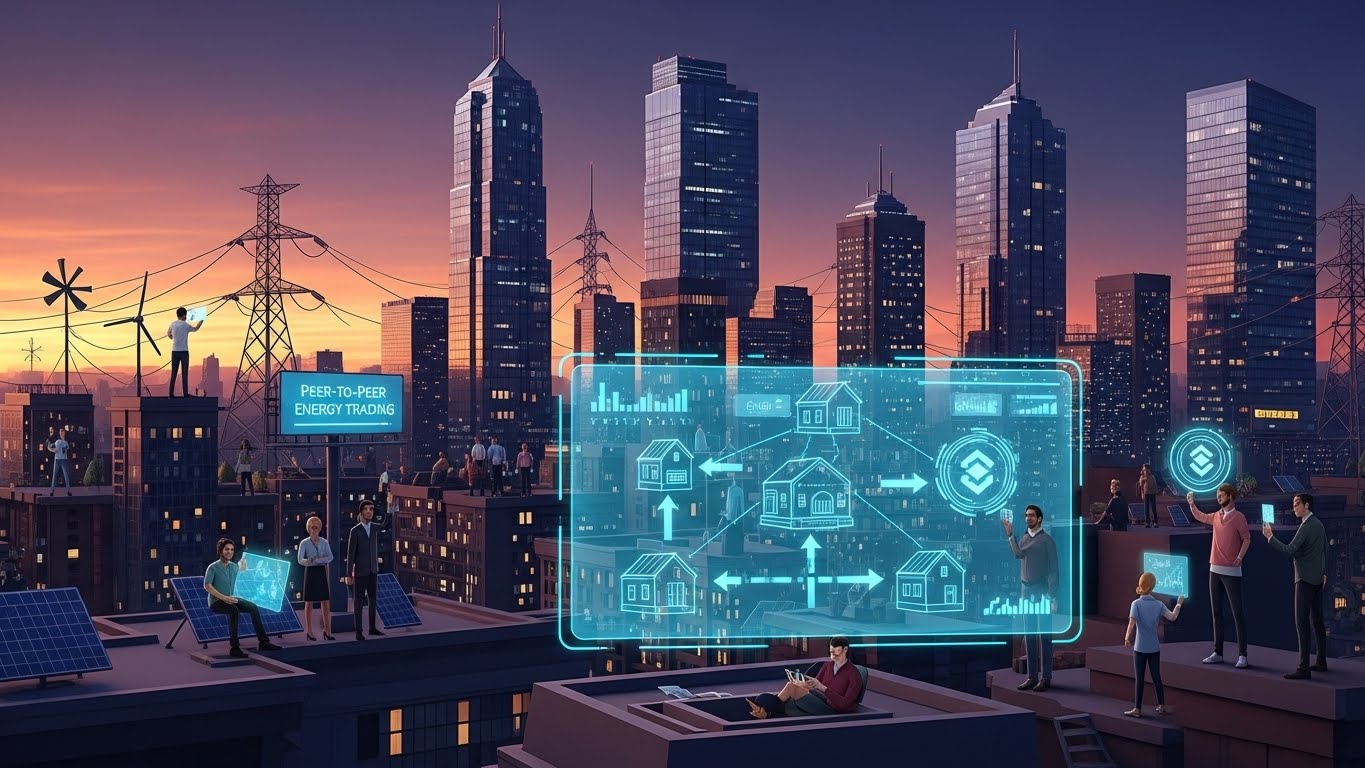
One of the most exciting ways blockchain is rewriting the global energy economy is through peer-to-peer energy trading. In a peer-to-peer system, households and businesses can sell excess solar energy directly to neighbors or local users instead of feeding everything into the grid at a fixed rate.
Traditional grids typically treat consumers as passive endpoints. But solar panels and batteries turn consumers into “prosumers,” meaning they both produce and consume energy. Prosumers want the freedom to monetize their excess power and buy energy when it’s cheaper or cleaner. Peer-to-peer trading supports that behavior and can make local energy ecosystems more resilient.
Blockchain supports peer-to-peer trading by recording transactions transparently and ensuring payments settle automatically. Instead of relying on a central marketplace operator, a blockchain ledger can act as the shared record that participants trust. This is especially valuable in microgrids, where local supply and demand fluctuate and where coordinating trades manually would be impractical.
Peer-to-peer trading also aligns with social preferences. Some consumers want to buy energy only from local renewable sources, or from community solar projects. Blockchain-enabled marketplaces can provide traceability, enabling consumers to choose energy sources based on values, not just price.
Blockchain and Renewable Energy Certificates: Trust at Scale
Renewable energy certificates are essential for proving that a certain amount of electricity was generated from renewable sources. They support compliance programs and corporate sustainability claims. But certificate markets can be complicated, involving multiple registries, verification processes, and potential delays.
Blockchain can streamline this process by creating a unified record of renewable generation and certificate ownership. When a renewable plant generates electricity, it could automatically issue a corresponding tokenized certificate. When a buyer purchases the certificate, ownership transfers on-chain, creating a clear audit trail.
This matters because renewable markets are expanding rapidly. Corporations want verifiable clean energy sourcing, and regulators want stronger integrity in sustainability reporting. Blockchain-based certificates improve transparency and reduce the risk of double counting, which is one of the biggest criticisms of existing systems. By improving trust and verification, blockchain is rewriting the global energy economy by accelerating the flow of renewable finance and making clean energy claims easier to validate.
Carbon Markets, Emissions Tracking, and the Token Economy
Carbon markets are another arena where blockchain is rewriting the global energy economy. Carbon credits represent measured reductions or removals of greenhouse gas emissions. These credits can be bought and sold to offset emissions, but carbon markets have long faced challenges such as inconsistent standards, double counting, and limited transparency. Blockchain-based carbon systems aim to track each credit from issuance to retirement, providing stronger accountability. Tokenized carbon credits can be easier to trade, and smart contracts can automate retirement once a credit is used for offsetting. This can improve credibility and reduce fraud.
Beyond carbon credits, blockchain can support emissions tracking across supply chains. Energy intensity and carbon footprint data can be recorded immutably, helping companies measure progress toward climate targets. As global reporting standards tighten, the demand for trustworthy emissions data is rising.
In the long run, tokenized carbon systems could integrate with tokenized energy systems. That means energy tokens could carry carbon metadata, enabling automated pricing based on environmental impact. This is one of the most powerful concepts behind the idea that blockchain is rewriting the global energy economy, because it merges economic value with environmental accountability.
Grid Flexibility, Demand Response, and Tokenized Incentives
Modern grids require flexibility. Renewable energy is variable, meaning supply can rise and fall depending on sun and wind conditions. To maintain stability, grids need demand response programs that encourage consumers to shift usage during peak times.
Blockchain can help by enabling tokenized incentives for flexible behavior. For example, a consumer could earn tokens for reducing consumption during peak demand. A business could earn rewards for allowing the grid to temporarily draw from its battery storage. These incentives can be settled automatically and transparently, making participation more attractive. This approach also supports grid balancing services, which are traditionally dominated by large players. Tokenization could open these markets to smaller participants like households with smart devices. Over time, thousands of small flexibility providers could collectively deliver the same stabilizing power as a large centralized plant.
Tokenized incentives can also reduce the need for expensive grid upgrades. If the grid can manage peaks with flexible consumption, it may delay or reduce infrastructure expansion costs. This is another way blockchain is rewriting the global energy economy: by shifting value from physical expansion to coordinated digital management.
Decentralized Energy Finance and Investment Models
Energy infrastructure requires capital. Traditionally, funding large power projects involves banks, utilities, government programs, and institutional investors. But distributed energy resources create a new finance challenge. Thousands of small solar rooftops or community microgrids can be harder to finance using traditional structures.
Blockchain-based finance, including tokenized investment models, could open energy investment to broader participation. A community solar project could issue tokens that represent ownership shares or revenue rights, allowing local investors to fund and benefit from the project. Smart contracts could distribute earnings automatically, improving transparency and reducing administrative costs.
This is where decentralized finance intersects with energy. The idea isn’t that every solar panel becomes a crypto investment, but that blockchain-based tools can make smaller energy projects financeable at scale. As more people seek clean energy investment opportunities, tokenized finance models could unlock new funding channels. If these systems mature, blockchain is rewriting the global energy economy by reshaping how energy projects are funded, owned, and monetized.
Real-World Use Cases: Where Blockchain Is Already Working in Energy
Blockchain in energy is not only theoretical. Real-world pilots and commercial deployments have been exploring peer-to-peer trading, renewable certificate tracking, and grid flexibility programs for years. The most successful projects tend to focus on clear problems like settlement automation and renewable traceability, rather than trying to overhaul entire grids immediately. Microgrids are a natural starting point. In a microgrid, energy generation and consumption are localized, making it easier to coordinate participants. Blockchain-based platforms can help manage these local markets, track usage, and settle payments.
Corporate renewable procurement is another promising area. Corporations increasingly want real-time verification of renewable sourcing, and blockchain-based tracking can provide more transparent proof compared to monthly or quarterly reporting.
In addition, regions with unreliable grid infrastructure can benefit from decentralized energy models. Blockchain can enable community-level energy accounting and payment systems, supporting solar mini-grids and local energy markets. These examples show that blockchain is rewriting the global energy economy incrementally, by solving specific trust and coordination problems in targeted environments.
Challenges and Limitations Blockchain Must Overcome
Despite its promise, blockchain adoption in energy faces serious obstacles. Energy systems are heavily regulated, and integrating new transaction models requires approval from regulators and utilities. Many electricity markets are not designed for peer-to-peer trading, and changing market rules can be slow.
Another challenge is data integrity. Blockchain can securely store data, but it cannot guarantee that the input data is accurate. If a smart meter reports incorrect readings or is compromised, blockchain will faithfully store incorrect information. Reliable sensors, secure metering, and robust verification processes are essential.
Scalability and energy consumption of blockchain systems are also important considerations. While many modern blockchain networks are far more energy-efficient than early proof-of-work systems, performance still matters when handling millions of micro-transactions. Finally, user experience is critical. Most consumers do not want to manage wallets, private keys, and token transfers to pay their electricity bill. For blockchain to rewrite the global energy economy at scale, the user interface must be seamless, with complexity hidden behind familiar applications.
Regulation and Governance in Tokenized Energy Markets

Regulation will determine how fast tokenized energy markets grow. Energy is not like typical consumer goods because it affects national security, economic stability, and public welfare. Governments carefully manage pricing structures, grid reliability, and consumer protections. Any blockchain-based marketplace must operate within this framework.
Governance is also crucial. If energy tokens represent tradable value, regulators will likely treat them as financial products in some contexts. That means compliance requirements, reporting obligations, and consumer safeguards will apply. However, regulation can also support adoption. Governments can encourage blockchain-based renewable tracking, emissions reporting, and incentive programs as part of climate strategies. The most likely outcome is a hybrid approach, where blockchain systems integrate with regulated utilities rather than replacing them. This hybrid model still supports the central idea: blockchain is rewriting the global energy economy, but it will do so through collaboration with existing structures, not through disruption alone.
The Future Outlook: What the Global Energy Economy Could Look Like
By the early 2030s, the global energy economy could look dramatically different. Energy markets may become more localized, with communities trading power through microgrids. Renewable generation could be tracked in real time, enabling accurate sustainability claims and faster clean energy investment. Consumers could earn tokenized rewards for saving energy, charging EVs off-peak, or providing battery flexibility to the grid.
In that future, the grid becomes less of a one-way infrastructure system and more of a digital platform. Tokens become a way to represent energy, value, and environmental impact in a single framework. Smart contracts automate trust, reducing the friction that currently slows energy market innovation. This is the heart of the “From Grids to Tokens” idea. Blockchain is rewriting the global energy economy by making energy more transparent, programmable, and participatory. It’s not about replacing the grid, but about upgrading the economic layer that sits on top of it.
Conclusion
From grids to tokens, blockchain is rewriting the global energy economy by transforming energy into something that can be tracked, verified, traded, and settled digitally. Tokenization enables new models of value exchange around electricity, renewables, grid flexibility, and carbon accountability. Smart contracts reduce friction by automating energy transactions and payments, while peer-to-peer trading empowers consumers to become active participants in local energy markets.
At the same time, this transformation will not happen overnight. It requires strong data integrity, regulatory alignment, consumer-friendly interfaces, and careful governance. But the direction is clear: as energy becomes more distributed and as sustainability demands grow, the world needs better systems to coordinate production, consumption, and environmental impact. Blockchain provides tools that can fill that gap. If the 20th century built the physical grid, the 21st century is building the digital energy economy. And as tokens, smart contracts, and decentralized coordination mature, blockchain will continue to rewrite how energy is priced, traded, financed, and trusted around the world.
FAQs
Q: How does blockchain is rewriting the global energy economy differently from traditional digital systems used by utilities?
Traditional utility systems are typically centralized databases controlled by one organization, which means trust depends on that single authority and reconciliation across multiple parties can be slow and costly. Blockchain is rewriting the global energy economy by creating a shared ledger that multiple participants can trust without needing one central controller. This enables faster settlement, transparent records of energy production and consumption, and automated execution of agreements through smart contracts. In practical terms, blockchain can reduce administrative friction and support new market structures like peer-to-peer trading and real-time renewable certification.
Q: Can tokenized energy really work at scale when electricity markets are highly regulated and complex?
Tokenized energy can work at scale, but it will likely grow through regulated integration rather than replacement of existing systems. Electricity markets require reliability, consumer protection, and compliance with pricing rules, so blockchain-based models must fit within those frameworks. The most realistic path is a hybrid approach where blockchain handles verification, settlement, and incentive mechanisms while utilities and regulators maintain oversight. This still allows blockchain to rewrite the global energy economy by improving transparency, efficiency, and flexibility, even inside regulated environments.
Q: What role do smart contracts play in making peer-to-peer energy trading possible for everyday consumers?
Smart contracts make peer-to-peer energy trading possible because they can automate transactions based on real-time data. If a household produces excess solar power, a smart contract can match it with a buyer, verify delivery through metering data, and settle payment instantly without manual billing. This automation reduces transaction costs, which is essential for small energy trades that would be uneconomical under traditional systems. Over time, this allows everyday consumers to participate in local energy markets without needing advanced financial knowledge.
Q: How can blockchain-based renewable energy certificates improve trust compared to current certificate registries?
Current renewable energy certificate systems often rely on multiple registries and manual verification processes, which can introduce delays and make it harder to ensure transparency. Blockchain-based certificates can create an immutable audit trail from issuance to ownership transfer to retirement. Because every transaction is recorded transparently, the risk of double counting or unclear ownership decreases. This improves trust for corporations, regulators, and consumers who want verified proof that renewable energy claims are backed by real generation.
Q: What are the biggest risks or downsides of using blockchain to rewrite the global energy economy?
The biggest risks include regulatory uncertainty, data integrity challenges, and user complexity. Blockchain can store trustworthy records, but if metering data is inaccurate or compromised, the blockchain will still store flawed information. Another downside is that many consumers do not want to manage digital wallets or tokens, so usability must improve significantly for mass adoption. Scalability and interoperability between systems also remain challenges. Despite these risks, the benefits of transparency, automation, and decentralized coordination make blockchain a compelling tool for the evolving energy economy.